
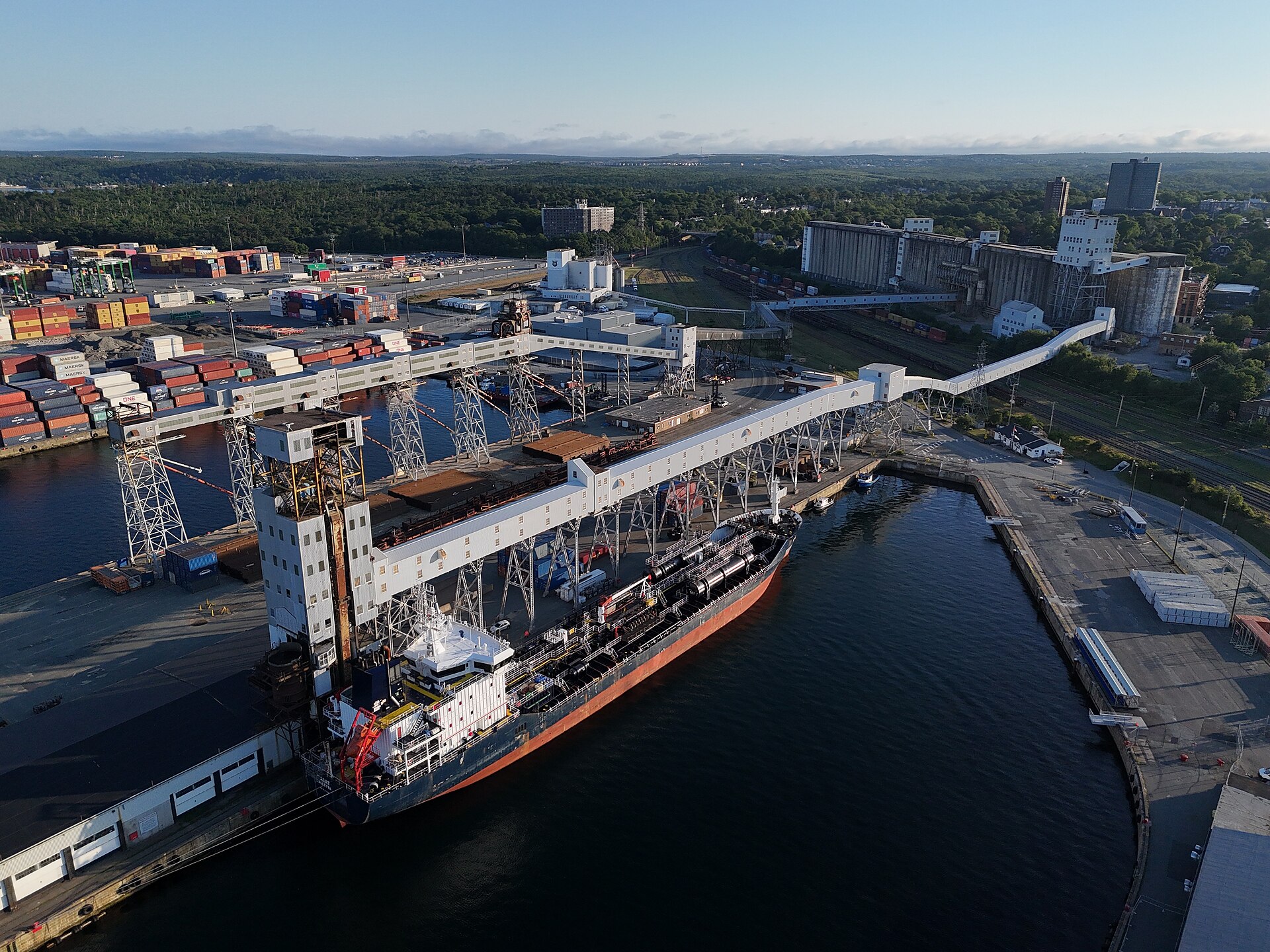
Hellenic Shipping News and industry freight notes into late 2023 and early 2024 described Red Sea security concerns prompting Cape of Good Hope reroutes, raising ton-miles and freights. Longer voyages raised delivered costs for Middle East sulfur and fertilizer cargoes into Asia and Europe. The freight note is at https://www.hellenicshippingnews.com/tighter-fleet-capacity-geopolitical-issues-longer-voyages-to-boost-2024-tanker-freight/.
Sulfur seaborne from Ras Laffan, Ruwais, Jubail, and Shuaiba toward China, India, and Morocco is a dry-bulk book that uses the same Red Sea and Suez lane as some fertilizer cargoes when it is going west or when Asia-bound vessels position through the canal. A Cape reroute adds weeks and bunker. Delivered CIF rises even if FOB does not.
Alberta recovered sulfur still leaves mainly through the Vancouver stem. Canadian Pacific solids do not transit Suez or the Red Sea. They rail to Port Moody and Vancouver and load into the North Pacific. A Red Sea risk premium on Gulf origins is, on a freight-adjusted basis, a relative bid for Vancouver tonnes into Asia. It is not a 2026 Hormuz closure. It is a longer voyage.
Argus's 14 December Vancouver FOB midpoint at $72 per tonne already included rising freight trimming netbacks. Higher ocean rates cut what is left for inland costs. A Cape premium on competing Gulf cargoes can support Vancouver CIF even while FOB stays soft. Two different prices, one longer map.
Tampa molten does not use Suez. US Gulf solids that leave for unusual destinations do. Mosaic's earlier utilization cuts had freed some Gulf sulfur for export. A Red Sea disruption that lifts Gulf-to-Asia delivered cost is an Atlantic-to-Pacific basis question. Florida phosphate still prices Tampa. Asian phosphate prices CIF.
Attacks cutting Suez transits about 14 percent, in the later 2024 intel file, are the 2024 print of this late-2023 risk. November 2023 is the beginning of the watch, not the annual statistic. Fertilizer nitrogen and phosphate cargoes lengthening is the wider complex. Sulfur moves with that complex when it shares vessels and canals.
China's 8.8 million tonne 2023 import year still cleared. UAE, Canada, and Korea at about 1.1 to 1.2 million tonnes each still arrived. Freight rose. Volumes did not vanish. The 2026 Hormuz commercial-shipment near-zero print is a different failure mode. Red Sea 2023 is delay and cost.
Figures follow Hellenic Shipping News industry notes. Licensed weekly grids are not restated. UNCERTAIN: sulfur-specific fixture lists versus the wider dry-bulk reroute commentary in the cited item.