
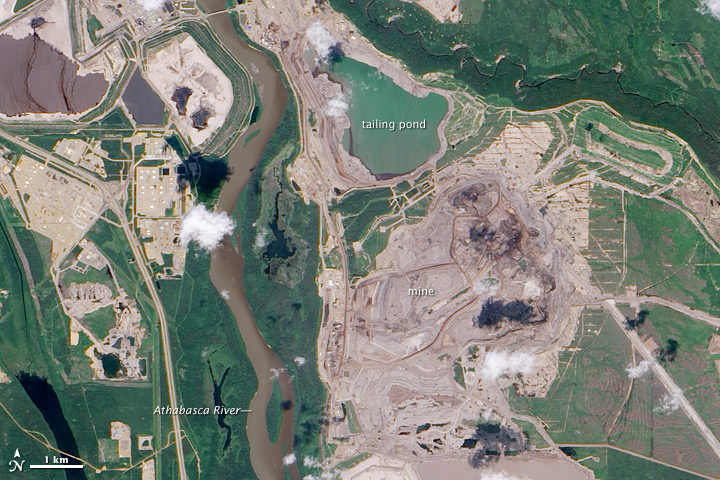
Industry commentary citing site inventory put Syncrude's Fort McMurray sulfur holdings at just over 9.9 million tonnes at end-November 2025, the first sub-10 million tonne print since 2019. Stocks were drawn by nearly 400,000 tonnes between end-2024 and November 2025. The CRU and BC Insight-linked commentary is the facility-level print under the provincial AER total.
Argus, citing AER, had put provincial Alberta sulfur inventory at 11.66 million tonnes in July 2025, the lowest since May 2019. Syncrude has historically held most of the Canadian pile. A facility print under 10 million tonnes is the oil-sands block that the world treats as the largest sulfur inventory, moving. It is not the provincial total. AER ST3 remains the province-wide series.
Mobilizing incremental Alberta blocks still requires excavate, melt, form, and rail logistics, limiting how fast Canadian inventory can replace lost Middle East seaborne supply. Remelt, rail, forming, and terminal charges have often been cited above $150 per tonne. Vancouver FOB averaging $238 per tonne in January-July, and $305-310 in early October, is what paid that chain in 2025. A 400,000 tonne facility draw is a year of that economics, not a week.
Heartland Sulphur increased remelt capacity at its Edmonton-area terminal by 40 percent to 700 tonnes a day, from 500, and plans 1,500 tonnes a day by end-2026, triple the original 2021 commissioning rate. That is crushed-bulk remelt into molten rail and Vancouver granules. Syncrude block still has to be excavated and melted before Heartland or any other former can form it. Capacity advertisements are not the 9.9 million tonne print. The print is the stock.
BC Insight's later March 2026 oil-sands note expected about 1.5 million tonnes of Canadian blocked sulfur to be remelted across 2025-2030. A 400,000 tonne Syncrude draw in eleven months is consistent with that pace at one facility. It is not a 1 million tonne a month Hormuz replacement. Swing supplier, in the 2026 SMM usage, is this draw plus the 4.25 million tonne 2025 export base.
Alberta recovered sulfur still leaves mainly through the Vancouver stem. VFPA put 2025 sulphur at 3.51 million tonnes. The Syncrude pile is the inventory behind those loadings. When the pile is above 10 million tonnes, the world talks about Canadian stocks as if they were infinite. When it prints 9.9 million, the world starts counting excavators.
USGS MCS 2026 put Canada production at 5.0 million tonnes 2025e. Oil sands, in BC Insight, were about 3.0 million tonnes of elemental output. Syncrude is a slice of that 3.0 million plus a slice of the historic block. The sub-10 million tonne print is the block, not the annual Claus recovery.
Russian export restrictions began in late 2025. Hormuz closed in February 2026. The November Syncrude print is the last pre-shock facility inventory on the file. Further 2026 remelt will take it lower if FOB stays above the $150-plus chain cost. Forming saturation, not the remaining 9.9 million tonnes, is the speed limit.
Figures follow the CRU and BC Insight-linked site inventory commentary. Licensed weekly grids are not restated.