
Shanghai Metals Market's 6 July first-half 2026 sulfur chain review remains the working national account on 20 August. Canada is framed as a critical swing supplier after Hormuz disruption and CIS export restrictions. The public article is at https://news.metal.com/newscontent/103989791-smm-analysis-h1-2026-sulfur-industry-chain-review-extreme-volatility-under-supply-shocks.
The review cited StatCan-style export tonnage growth and elevated Vancouver FOB in early 2026. The quantified H1 version put 2025 Canadian sulfur exports at 4.25 million tonnes, up 40.7 percent year on year, and first-four-month 2026 export value at $1.049 billion, annualized near 5.22 million tonnes, with Alberta and British Columbia more than 95 percent of national sulfur exports.
Twenty August sits between TFI's 18 August phosphate-bottleneck warning and the 21-22 August customs and tariff items. The H1 frame is what those later items plug into. It is not superseded by them. A swing supplier can still have a softer June, a Tampa record, and a US tariff watch without ceasing to be the Pacific origin that filled a Gulf hole.
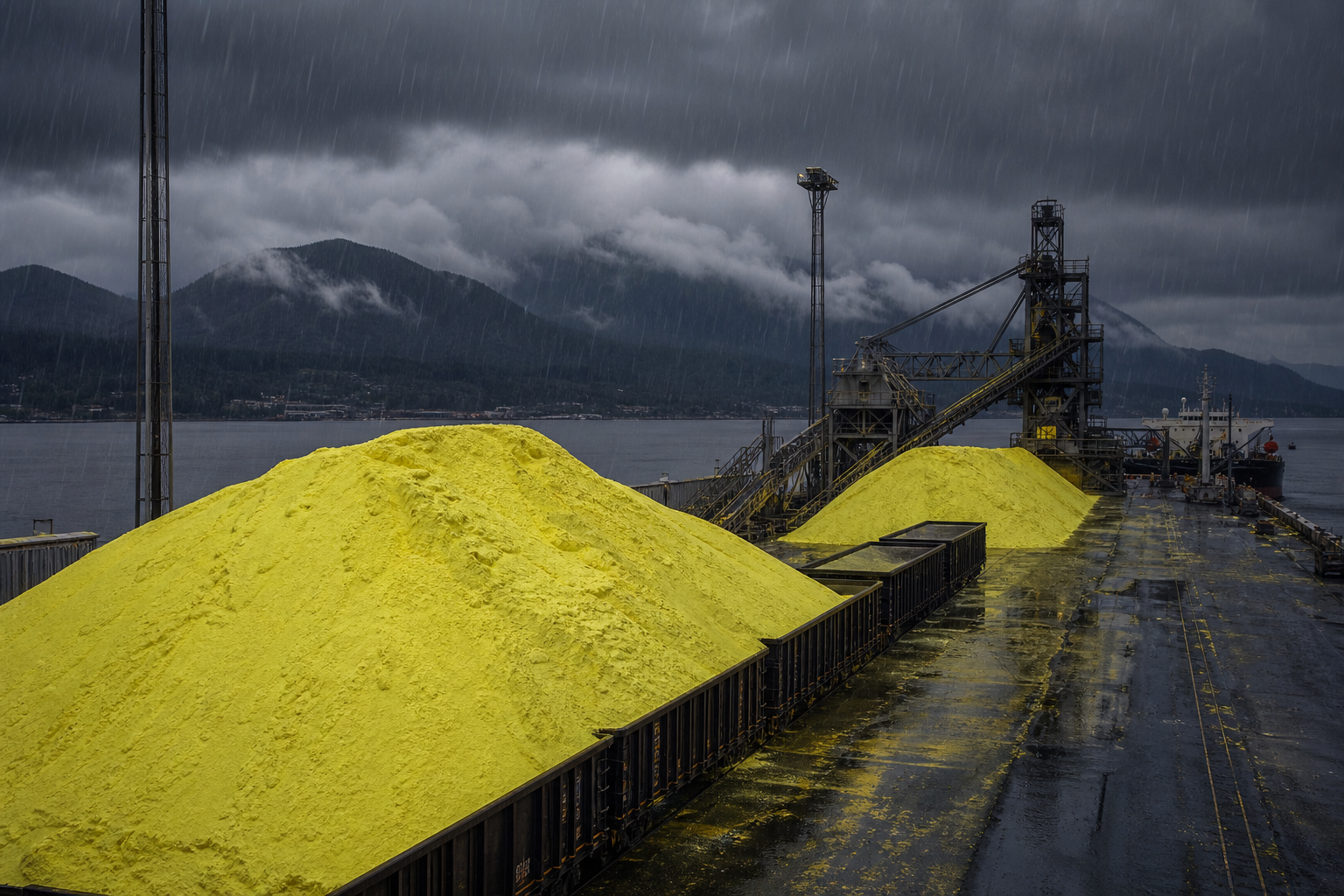
VFPA's 2025 sulphur total of 3,507,428 tonnes is the port confirmation under that national pace. Destination mix in the same PDF put China at 1.30 million tonnes, down 16 percent, and the United States at 302,000 tonnes, up 191 percent. The stem diversified while it grew. That is the Alberta forming-plant read: more tonnes, less China concentration.
FOB Vancouver in the SMM path moved from about $500 per tonne in January 2026 toward $825-950 per tonne by April. Tampa Q3 molten later settled at $705 per long ton delivered in Argus open news (https://www.argusmedia.com/en/news-and-insights/latest-market-news/2851577-tampa-3q-liquid-sulphur-price-hits-record-705-lt). US Gulf spot solids in that cycle were $1,100-1,150 per tonne FOB. The Pacific discount to Gulf solids is a basis, not a soft market.
CRU's mid-July update still had Middle East sulfur exports down more than 1.0 million tonnes a month since March, with production loss near 2.3 million tonnes and more than 0.5 million tonnes loaded and stranded inside Hormuz. A Canadian swing role that began in that hole does not end because a 6 July article is three weeks old.
Oil-sands sulfur, in BC Insight's 23 March estimate, was about 3.0 million tonnes in 2025, 63 percent of Canadian output. Recovery tracks bitumen and sour-gas throughput, not the sulfur bid. Remelt of blocked inventory is the only volume that sulfur price can summon on a 2026 calendar, and CRU put that remelt at about 1.5 million tonnes across 2025-2030.
Alberta recovered sulfur still leaves mainly through the Vancouver stem. World supply shocks show up there as stem tightness, remelt draws, and Gulf-versus-Pacific basis. The 20 August desk keeps that sentence on the H1 SMM frame until a new StatCan HS 2503 table or a new VFPA monthly changes the tonne count.
No new national customs table is claimed in this item. The H1 review is context. Licensed weekly assessment grids are not redistributed.