
Shanghai Metals Market published its Canada sulfur and sulphuric acid import and export review on September 8, putting July 2026 monthly sulfur exports at 444,100 metric tonnes.
The July print is down 15.76 percent month on month and up 46.28 percent year on year, at an average export price of 1,181 dollars per metric tonne in SMM's customs aggregate.
Major destinations were the United States at 172,200 tonnes, Indonesia at 75,200 tonnes, Australia at 66,000 tonnes, Morocco at 51,400 tonnes, China at 33,000 tonnes, and Papua New Guinea at 32,500 tonnes.
The United States lane remains the largest single destination, consistent with Canada's role as the dominant US import source for recovered sulfur in USGS trade tables.
Indonesia and Australia together account for more than 140,000 tonnes in the July account, confirming Pacific and Indo-Pacific nomination breadth beyond the cross-border molten and solid lanes.
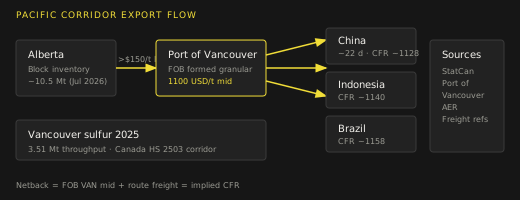
China's 33,000 tonnes in July is a smaller share than the US lane but still material for Vancouver stem timing when Shengyishe's national benchmark corrects through early September.
Monthly sulfur imports totalled 881 tonnes, down 17.91 percent month on month, overwhelmingly from the United States at 856 tonnes with a small China line at 25 tonnes.
Sulphuric acid exports were 159,800 tonnes at an average 217 dollars per tonne, overwhelmingly to the United States, with a very small volume to the Netherlands.
Sulphuric acid imports were 8,126 tonnes at 235 dollars per tonne, almost entirely from the United States at 8,085 tonnes.
Alberta and British Columbia account for more than 95 percent of national sulfur exports in SMM's H1 2026 chain review, so the July customs print is primarily a read on forming plants and Pacific terminals.
Sultran's nine inland Alberta and BC facilities and Pacific Coast Terminals in Port Moody remain the logistics backbone for those tonnes, with CN and CPKC rail into Vancouver export terminals.
Middle East seaborne through Hormuz stays impaired in open trade reporting, which keeps Canada on swing-supplier status for buyers in China, Indonesia, Australia, and Morocco.
Shengyishe's September 9 national benchmark at 8,126.75 yuan shows domestic Chinese prices correcting, but four-digit export prices in the July customs account confirm Pacific netbacks remain commercially active.
Desk read: July customs confirm breadth across six destination lanes at an average near 1,180 dollars per tonne. Alberta inventory and Vancouver loadings stay commercially relevant even as the Chinese national index corrects.