
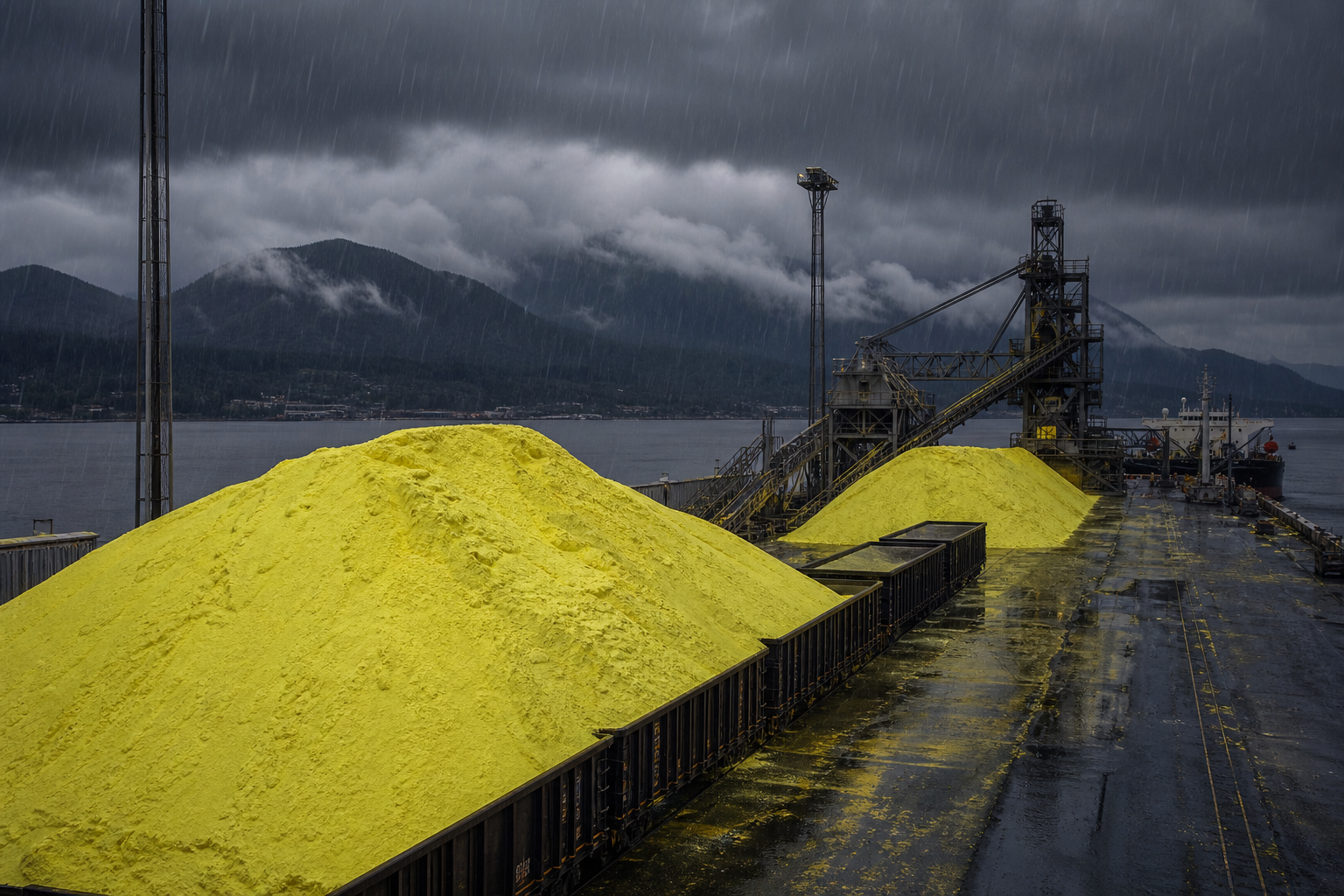
University of Illinois farmdoc daily on August 25 linked rising US Corn Belt diammonium phosphate prices to Vancouver spot sulfur exceeding $1,000 per tonne in recent weeks.
Authors Nick Paulson, Gary Schnitkey, Carl Zulauf, and Aayush Dhakal wrote that sulfur climbed from less than $100 per tonne in 2024 to more than $200 by spring 2025, passed $400 at year-end 2025, and has recently exceeded $1,000 per tonne.
The sharp move since March 2026 reflects Middle East logistical disruption from the Iran conflict plus export restrictions from major producers including China and Russia to protect domestic supply.
Corn Belt DAP averaged $600-$700 per tonne through 2024 and the first half of 2025, rose toward $850 in fall 2025, dipped near $700 early in 2026, and returned to about $850 in recent weeks.
Since 2024 the correlation between Corn Belt DAP and Vancouver sulfur prices is 0.70, statistically strong. Corn Belt DAP and anhydrous ammonia correlate at 0.65 over the same window.
Anhydrous ammonia fell from around $600 per tonne in early 2024 to under $500 in summer 2024, climbed above $750 by fall 2025, spiked toward $1,000 after the Iran war began, and has since retreated to about $750.
The authors note input cost spikes often pass through to finished fertilizer prices with a lag as firms adjust procurement and pricing. A sustained sulfur spike could lift DAP further into the fall 2026 booking window for 2027 acres.
DAP production combines mined phosphate rock with sulfuric acid made from sulfur, then ammonia. Typical input ratios run 1.5-2 tonnes of rock with 0.4 tonnes of sulfur and 0.2 tonnes of ammonia per tonne of DAP.
USGS 2026 Mineral Commodity Summaries put China at 23% of global sulfur production, the United States at 10%, Russia at 8.9%, Saudi Arabia at 8.6%, the UAE at 7.5%, Canada at 6%, and Kazakhstan at 5.7%.
US net import reliance on sulfur and sulfuric acid was 14% in 2024 and 2025, similar to phosphate rock import reliance. US farmers remain exposed to global disruptions even with large domestic oil and gas sulfur recovery.
Vancouver is the Pacific export stem for Alberta forming plants. A Corn Belt DAP print near $850 with Vancouver sulfur above $1,000 is the North American cost chain the farmdoc chart makes visible for fall fertility decisions.
Tampa remains the US phosphate molten contract hub. The farmdoc piece uses Vancouver spot, not Tampa or Gulf solids, as the sulfur series tied to Corn Belt DAP, which fits the Pacific swing-supplier role Canada has held since Hormuz disruption.
Desk read: the 0.70 correlation is an extension desk tool, not a price assessment. It confirms phosphate affordability is tracking Pacific sulfur spot with a lag as the industry enters the fall 2026 application and purchase window.