
Shengyishe's September 8 oscillation model reversed the September 7 strong-consolidation read after the benchmark's 5.06 percent one-day drop to 8,201.75 yuan per tonne.
The five-day average spread fell to negative 342.47 from 14.67, a 357-point collapse that erased the positive momentum the platform had flagged September 7.
The ten-day spread turned negative at negative 17.05 from positive 6.33, crossing below zero for the first time in the early-September window.
The twenty-day spread narrowed to negative 303.87 from negative 312.17, continuing the negative contraction that began September 6 but not enough to offset the five- and ten-day deterioration.
Shengyishe classified the (-, -, +) combination as deep correction with bearish oscillation, distinct from the (-, +, +) strong-consolidation signal that held through September 7.
Position reference put sixty-day and three-month cycles in the lower price band, implying limited further downside after the sharp session.
The one-year cycle remains in the mid-high band with callback pressure from the June 2026 peak above 11,000 yuan and the 11,084.33 yuan annual maximum in Shengyishe's trailing-year statistics.
Port inventory at 965,700 tonnes on September 7 continues to weigh on spot even as the national benchmark corrects, a pairing PriceSeek flagged as bearish.
Zhenjiang held 221,200 tonnes and Fangchenggang 390,000 tonnes in the September 7 port breakdown, with no September 8 inventory update published at the time of the technical read.
Longzhong's September 4 review had described early September firming as a bounce with autumn phosphate fertilizer stocking below expectations. The deep-correction signal tests whether that bounce has exhausted.
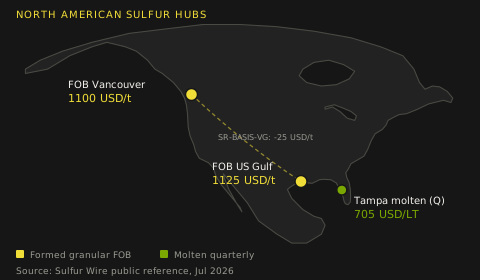
For Alberta and British Columbia recovery tonnes, a weakening Chinese national index narrows the Pacific nomination window against which stems bid into Indonesia, India, and the Yangtze.
SMM's open analysis earlier in 2026 described Canada filling gaps in those markets while rail capacity stayed saturated, with FOB Vancouver rising from roughly 492 dollars per tonne at the start of the year toward the 680 to 720 dollar range by spring.
Middle East seaborne through Hormuz remains impaired in open trade reporting, so Chinese port inventory and domestic refinery output matter more than Gulf contract postings for Pacific nomination timing.
Desk read: September 8 technical indicators confirm a regime shift from strong consolidation to deep correction. Pacific sellers should watch whether port granular prices follow the national index lower or whether the sixty-day lower-band reference limits further downside.