
Reuters reported September 14 that preliminary shiptracking data showed commodity vessel transits through the Strait of Hormuz fell to a single digit per day at the weekend.
The weekend count sat well below a 10-day average of 14 transits per day in the same dataset.
Over the weekend four vessels exited the Gulf through the strait: a Handysize sailing in ballast, a Handy carrying LPG, a Supramax carrying fertilizer, and a Suezmax laden with crude or condensate.
Ten vessels entered, including a mini-bulker carrying minor bulk commodities, a Handymax with grain, a Panamax with metals, and a Supramax with dry bulk cargo.
The figures exclude vessels that may have crossed with automatic identification system transponders turned off to avoid detection.
UKMTO reported early Sunday that a vessel was struck by an unknown projectile while transiting Hormuz, with crew status and damage assessment initially unknown.
Before the February 28 conflict the strait typically handled about 125 large commercial vessels per day, including tankers, gas carriers, bulkers, and container ships.
That pre-war flow accounted for roughly 20 percent of the world's daily crude oil and liquefied natural gas supply in open reporting.
Fertilizer Daily cited the WTO-AXSMarine Strait of Hormuz Trade Tracker showing fertilizer shipments remain near zero in early September despite the Iran-Oman safe-route memorandum.
The tracker noted substantial sulfur volumes also moved through Hormuz before the disruption, with phosphate producers in Egypt, Brazil, and India reducing output on high feedstock costs.
Saudi Arabia's East-West pipeline shutdown after drone strikes removes a key Red Sea bypass while Hormuz traffic stays impaired.
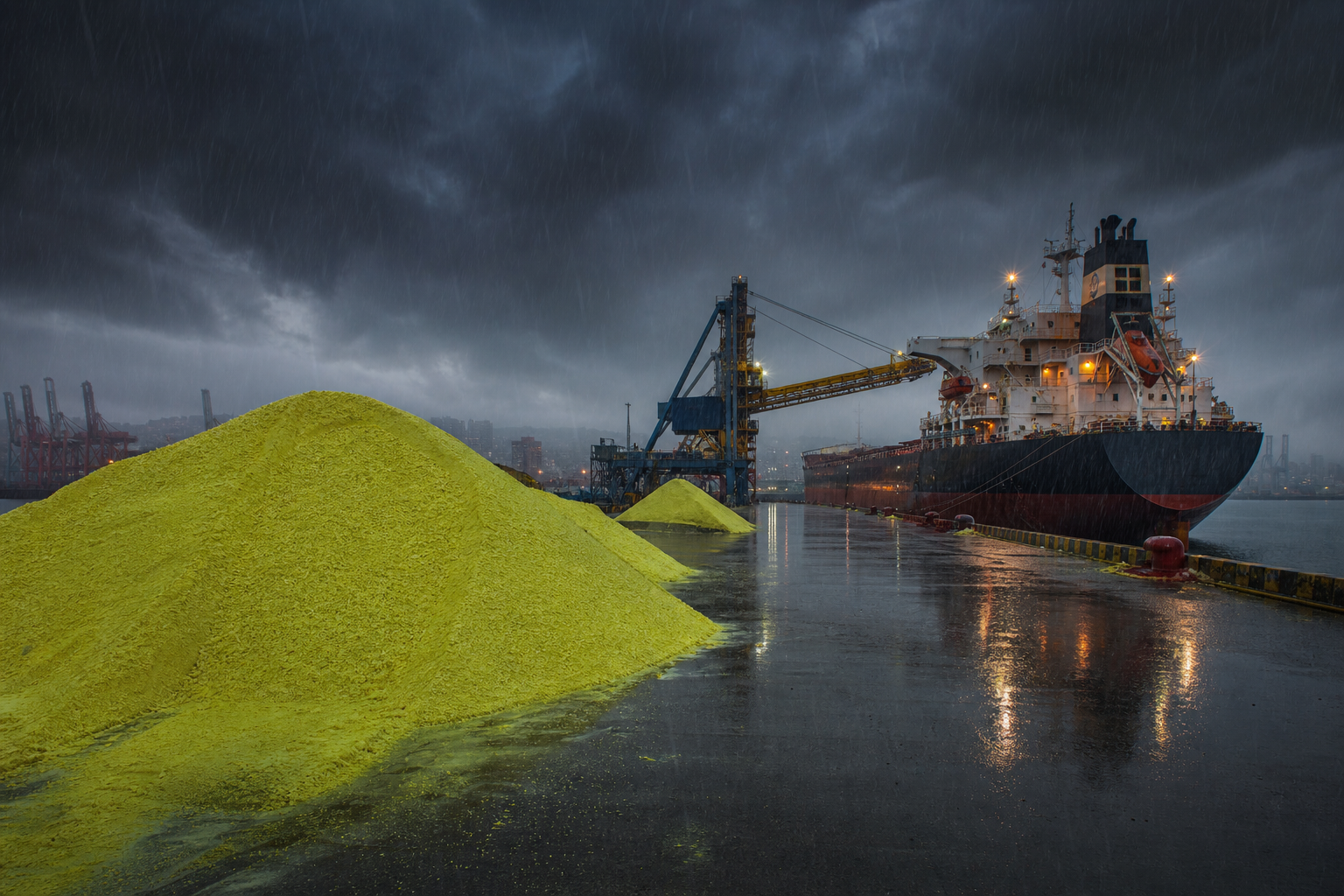
For Alberta forming plants and the Vancouver stem, single-digit Hormuz transits confirm Middle East sulfur is still not returning to the seaborne market at scale.
Pacific loadings and inventory draws that priced FOB Vancouver through 2025 and early 2026 remain the practical North American supply answer.
Desk read: September 14 is an AIS count, not a price quote. One Supramax carrying fertilizer through Hormuz does not reopen the sulfur lane; watch whether Salalah diplomacy produces any insured bulk restart.