
BC Insight's September 19 sulphur market update by Harrisson argued the market remains in a deep 2026 deficit after months of Middle East export disruption and phosphate demand destruction.
Middle East supply accounted for roughly 45 percent of seaborne trade in 2025 in the open summary, framing why Hormuz congestion hits the entire Pacific and Atlantic price stack.
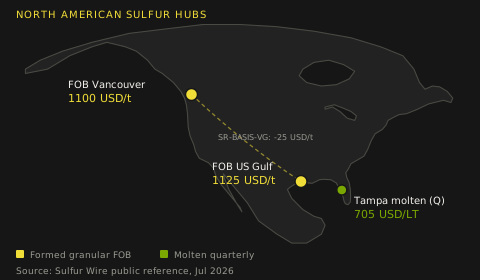
Production losses near 2.3 million metric tonnes and monthly exports falling below 1.0 million tonnes per month since March were cited as the mechanical tightness behind spot levels near 1,100 to 1,200 dollars FOB.
Prices were described as rising from about 500 dollars per tonne FOB pre-conflict to 1,100 to 1,200 dollars by late June, a range BC Insight's September 19 Price Trends still treated as steady for North America.
Phosphate producers including OCP, Mosaic, and Chinese plants cut output in the same narrative, linking sulphur scarcity to fertilizer margin stress on both sides of the Pacific.
Russia and Kazakhstan rail disruption, more than 0.5 million tonnes loaded but stranded, and more than 1.0 million tonnes of on-land inventory were listed as secondary bottlenecks beyond Hormuz sailings.
Harrisson's view that export rates could recover above 1 million tonnes per month in August and September sits against BC Insight's count of 380,000 tonnes still inside the Gulf on eight vessels as of 19 September.
UkrAgroConsult's September 18 reporting cited Mosaic near 50 percent rates in Florida and Louisiana with Tampa delivered sulfur above 1,100 dollars per tonne since May, the US Gulf mirror of the deficit story.
SMM's August customs put China sulfur imports down 65 percent year on year at 272,323 metric tonnes, showing import demand still thin even as global supply narratives stay tight.
Shengyishe's September 21 trend labeled a strong rebound on improved short spreads while spot held 7,669 yuan unchanged, a China technical read that does not yet confirm demand recovery.
For Alberta, AER ST3 July 2026 closing inventory at 11,109,610.9 tonnes with July removals from Alberta at 183,631.4 tonnes shows blocks still moving to rail and Vancouver when FOB economics clear forming costs.
The Vancouver Fraser Port Authority reported 3,507,428 metric tonnes of sulfur exports in 2025, up 5 percent year on year, with the United States listed at 302,000 tonnes, up 191 percent year on year.
Desk read: Harrisson 19 September is the supply thesis behind steady NA FOB. Pair deficit language with measured Alberta draws in AER ST3 rather than assuming Chinese spot weakness ends the tightness.