
Outlook · 2023-03-15
2023 softness with North American output recovery
Early 2023 opened in a soft sulfur price environment after the 2022 collapse, while Argus expected elevated North American output from resilient fuel demand and Canadian bitumen processing to stabilize prices. USGS Mineral Commodity Summaries 2024 reports Tampa contract sulfur began 2023 around $90 per long ton, rose to $130 in mid-January, then fell to $55 by mid-July, with the fourth quarter later at $102. First-quarter 2023 is the $90-to-$130 window, still far below the early-April 2022 peak of $481. Lost refining capacity since end-2019 still meant a full return to 2018 sulfur output was unlikely, Argus said, but US Gulf availability was expected to improve as domestic consumption moderated. The outlook was stabilization, not a flood.
USGS later estimated 2023 US sulfur production about unchanged from 2022 near 8.6 million tonnes, elemental recovered about 8.0 million, shipments valued about $860 million, average elemental unit value about $100 per tonne after $150 in 2022. Argus citing USGS put January-September production just over 6 million tonnes, with only the Gulf Coast region up, 3.57 million tonnes, plus 3 percent. Mosaic's sinking utilization through 2022, expected to continue into 2023, freed more US Gulf volume for export as domestic phosphate runs stayed weak. Higher refinery sulfur plus weaker phosphate consumption is the Atlantic surplus recipe that first-quarter Tampa at $90 already priced.
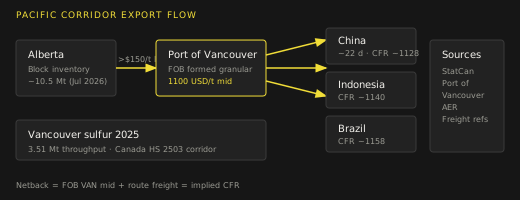
Alberta recovered sulfur still leaves mainly through the Vancouver stem. AER data cited later by Argus would put January-October 2023 Alberta sulfur production at 3.78 million tonnes, up 386,000 tonnes or more than 11 percent, as bitumen and heavy sour crude bolstered oil-sands sulfur toward record highs. Port of Vancouver sulphur would finish 2023 at 3,103,912 tonnes, up 11 percent from 2.79 million in 2022. First-quarter 2023 does not yet have those annuals. It has forming plants, unit trains, and a harbour that had already jumped 22 percent in 2022 and was not going to idle because FOB had left the $478 peak. Argus reported that earlier in 2023 suppliers were remelting solid sulfur inventory to keep pace with exporter demand. Remelt is the swing valve. It was still open in the first quarter. Late-year $72 FOB would close the high-cost end of it.
Vancouver-linked capacity discussions included the South Cheecham priller, with Argus suggesting a potential 5 to 10 percent uplift to Vancouver-linked export capacity in 2023 subject to demand. Keyera would report commencement at the beginning of the third quarter, about 4,400 tonnes a day near Fort McMurray, joint venture with Enbridge, gross cost about $285 million. First-quarter 2023 is still the construction-and-contract year, not the operating year. Heartland Sulphur's about 4,500 tonnes a day of forming at the Industrial Heartland terminal, commissioned around 2021, remained the Edmonton-area remelt-and-form node. Two geographies, one recovered stream.
China was expected to resume phosphate export customs inspections from January 2023, Argus said, continuing to restrain sulfur demand intensity versus the first-half 2022 surge, when April-June imports had jumped 50 percent to 2.4 million tonnes before the July de-facto quota. Domestic Chinese sulfur capacity growth further reduced opportunistic import need. IndexBox later put 2023 Chinese sulfur imports at 8.8 million tonnes, up 16 percent after three years of decline, value about $1.1 billion, down from about $2.3 billion in 2022. Canada supplied about 1.2 million tonnes. First-quarter 2023 is selling into that cheaper recovered bid, not into a 2022-style CIF explosion. IFA's later 2023 MAP and DAP at 64.3 million tonnes, up 3 percent, still below 2020, is the phosphate volume those inspections allowed.
Indonesian HPAL is the second demand book. S&P Global Energy later reported Indonesia imported about 2.7 million tonnes of sulfur in 2023, three times 2020, plus about 1 million tonnes of sulfuric acid. CRU put acid imports at nearly 1.1 million tonnes from 0.31 million in 2022. BC Insight estimated global nickel-related sulfur use at 3.5 million tonnes in 2023, from 1.7 million in 2020. First-quarter 2023 is when that metals bid is already large enough to compete with phosphate for seaborne tonnes even while Tampa sits at $90. It is not yet the organizer of the Vancouver stem. China still is.
Kazakhstan had begun a crushed-lump stock-draw programme around 2023 after a government fine over about 1.7 million tonnes of Kashagan stock. Saudi Arabia would add about 0.15 million tonnes a quarter from storage as pads neared capacity. Those draws are not Canadian remelt. They are regulatory and storage-driven tonnes into a surplus USGS would put at about 85.8 million tonnes world production, Canada about 4.98 million. First-quarter 2023 is the output-recovery thesis before those destocks and Chinese softness fully printed.
Alberta recovered sulfur still leaves mainly through the Vancouver stem. World surplus shows up there as a harbour that can still grow while remelt stays a high-hurdle decision. Phosphate buyers that had been burned by the 2022 spike entered 2023 with leaner inventories and more patience, extending the soft tone. For Canadian logistics operators, the commercial task was to keep forming and rail utilization intact through a low-margin window so that capacity would exist when the next firm phase arrived in 2025. Licensed weekly assessment grids are not restated here. UNCERTAIN: how quickly Cheecham forming would actually translate into incremental Vancouver loadings in the first half. The 3.10 million tonne annual would later show the corridor cleared. First-quarter remelt, not the July start date, is what first-quarter stems used.
Key points
- Argus viewpoint: 2023 NA sulfur output rise expected to reduce volatility after 2021-22.
- South Cheecham wet prilling cited as potential Vancouver export capacity support.
- Price environment remained far below mid-2022 highs.
- Alberta remelt stayed selective while FOB soft.
- UNCERTAIN: H1 2023 Vancouver monthly run-rate vs full-year 3.10 Mt outcome.
30-day watchlist
- USGS or trade-press confirmation of Tampa holding the mid-January $130/lt step or fading.
- Any public note on early-year Alberta remelt still pacing exporter demand.
- Chinese first-quarter import run-rate versus the later 8.8 Mt recovery year.
- South Cheecham construction-to-operations commentary ahead of Q3 start.
Sources
- Viewpoint: Sulfur volatility to wane as supply recovers (Argus)
- USGS Mineral Commodity Summaries 2024 - Sulfur
- Port of Vancouver 2023 Statistics Overview
Public reference summary. Weekly PRA assessments require a commercial license. Not investment advice.
Public-source summary. Not investment advice. Unsubscribe from the email edition: reply UNSUBSCRIBE or email [email protected].