Sulfur Wire North American sulfur intelligence

Outlook · 2023-06-15

Vancouver volume path toward a three-million-tonne year

Alberta to Vancouver sulfur export corridor diagram
Alberta recovery and forming to rail to tidewater. The corridor that prices FOB Vancouver. Sulfur Wire · Original
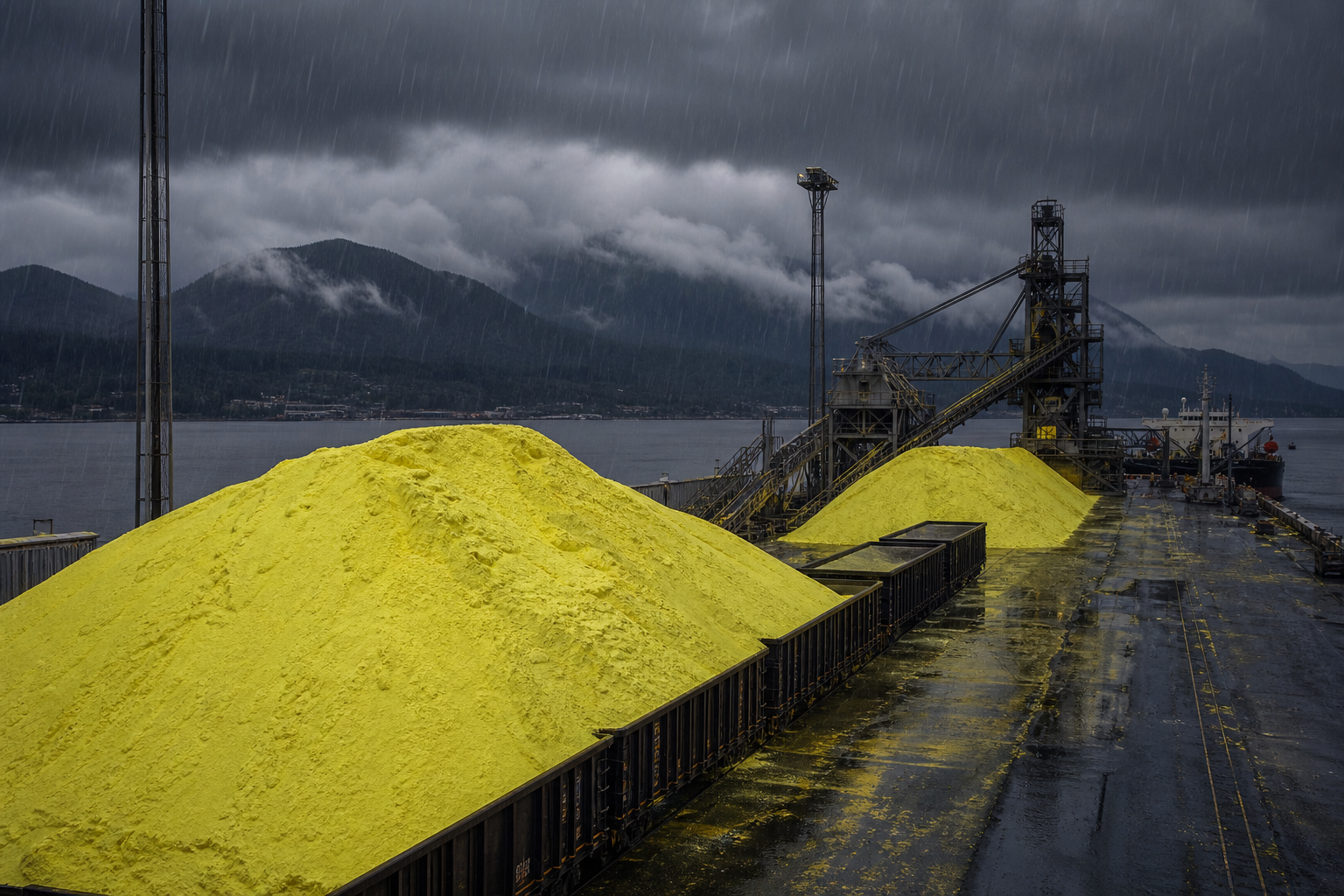
Port of Vancouver harbour. Pacific sulfur loadings leave here after Alberta rail.
Port of Vancouver sulfur, annual Mt 2018 2.3 2019 2.5 2020 2.7 2021 2.3 2022 2.8 2023 3.1 2024 3.3 2025 3.5 VFPA Statistics Overview (verified_public)
Port of Vancouver sulfur, annual VFPA Statistics Overview (verified_public)

Through mid-2023, Port of Vancouver sulphur was on track for a step-up year. Full-year 2023 port statistics later confirmed 3,103,912 tonnes, an 11 percent increase from 2.79 million tonnes in 2022, contributing to record bulk exports. The Vancouver Fraser Port Authority's cargo release put overall port trade at 150.4 million metric tonnes, up 6 percent, with sulfur among the growth commodities. Volume growth amid still-moderate prices showed that Canadian solid sulfur had become a structural Pacific staple for Asian and other buyers, not only a spike-year swing. Forming capacity inland and dedicated terminal handling at Port Moody and related Vancouver facilities supported the higher run-rate.

USGS placed Tampa at about $55 per long ton in mid-July 2023, the softest print of the year, after an open near $90 and a mid-January spike to $130. Mid-2023 is the slide into that trough. Soft Tampa and FOB markets limited inventory-draw incentives for high-cost Alberta remelt. Argus had reported that earlier in 2023 suppliers were remelting solid sulfur to keep pace with exporter demand. By mid-year that valve was already under pressure. Export-process costs often cited above $150 per tonne do not clear at mid-year Tampa of $55 or at the $72 Vancouver FOB midpoint Argus would print in mid-December. Current recovery still loaded. Remote block waited.

Alberta recovered sulfur still leaves mainly through the Vancouver stem. AER data cited by Argus later put January-October Alberta production at 3.78 million tonnes, up 11 percent, as oil-sands bitumen and heavy sour crude lifted sulfur recovery. USGS MCS 2025 listed 2023 Canada sulfur about 4.98 million tonnes. BC Insight later summarized about 4.5 million tonnes Canadian production, 2.6 million from oil sands, 1.7 million from sour gas, domestic use 0.6 million, exports 4.1 million with a modest stock draw, Vancouver about 2.8 million of the solid export, about 1.3 million tonnes molten south to the United States. Mid-2023 is that dual-outlet map in motion. USGS MCS 2024 still had Canada at 77 percent of US elemental sulfur imports for 2019-22. Molten rail is that share. Pacific solid is the harbour.

South Cheecham sulphur facilities were days from commencing at the beginning of the third quarter, Keyera would report, about 4,400 tonnes a day of forming near Fort McMurray, joint venture with Enbridge, gross cost about $285 million. Mid-June is the last month before that geography change. Heartland Sulphur's about 4,500 tonnes a day at the Industrial Heartland terminal remained the Edmonton remelt-and-form node. Argus had estimated Cheecham could lift Vancouver-linked export capacity 5 to 10 percent subject to demand. Demand in a $55 Tampa world is term offtake, not a remelt boom. Utilization in the first operating months would remain incomplete in open sources, with Argus later citing January-May 2024 startup issues.

China's 2023 sulfur imports recovered 16 percent to 8.8 million tonnes, IndexBox, after three years of decline, value about $1.1 billion. Canada, South Korea, and the UAE at about 1.1 to 1.2 million tonnes each were the top three origins, together about 39 percent. Gulf granular still competed with Vancouver into Yangtze plants whenever freight and FOB aligned. Argus had expected January 2023 phosphate-export customs inspections to restrain sulfur demand intensity versus the first-half 2022 surge. IFA put 2023 MAP and DAP at 64.3 million tonnes, up 3 percent, still below 2020. Mid-2023 Chinese buying is a volume recovery at cheap CIF, not a 2022 spike.

Indonesian HPAL is the metals offset. S&P put 2023 Indonesian sulfur imports at about 2.7 million tonnes, three times 2020, acid imports about 1 million tonnes. CRU put acid imports at nearly 1.1 million from 0.31 million in 2022. BC Insight put global nickel-related sulfur use at 3.5 million tonnes, from 1.7 million in 2020. Mid-2023 is when industry outlooks treated battery-metals acid as structural demand that could firm markets even when phosphate affordability was weak. It had not yet rewritten Vancouver's destination mix. China 1.2 million tonnes still organized the stem.

Kazakhstan's Kashagan fine over about 1.7 million tonnes of stock had triggered a crushed-lump removal programme. Saudi Arabia added about 0.15 million tonnes a quarter from storage. Those destocks continued through the surplus for reasons that were not Canadian netbacks. CRU's contrast is the desk read: Canada remelt is price-driven; Kazakh and Saudi draws are not. USGS world production about 85.8 million tonnes is the Claus planet those regimes sat on. US production about unchanged at 8.6 million tonnes, Gulf Coast nine-month output up 3 percent, is the Atlantic length.

Alberta recovered sulfur still leaves mainly through the Vancouver stem. World surplus shows up there as a harbour heading toward 3.10 million tonnes while remelt of remote block stays a high-hurdle decision. Destination diversification was already underway even if monthly public matrices are incomplete. The second quarter thus sits as the volume-growth chapter of the five-year story, distinct from both the 2022 spike and the 2025 remelt draw. Licensed weekly assessment grids are not restated here. UNCERTAIN: destination mix shift magnitude in mid-2023 without a public monthly destination matrix. The 3.10 million tonne annual and IndexBox's 1.2 million tonne Canadian share into China are the verified public anchors. Sultran's rail programme, more than 1,500 gondola cars to Port Moody and North Vancouver, is the inland backbone that made an 11 percent harbour increase possible while Tampa sat at $55. Forming plants and unit trains, not a new Claus industry, set that run-rate.

Key points

  • Port of Vancouver: 2023 sulphur 3.10 Mt (+11% YoY) in authority/trade summaries.
  • Bulk exports set records in 2023 with sulphur among growth commodities.
  • Volume can rise even when prices are soft if logistics and term contracts hold.
  • Pacific Canadian corridor deepened as a routine Asia supply lane.
  • UNCERTAIN: mid-year destination split China vs SE Asia vs other.

30-day watchlist

  • USGS mid-July Tampa print versus the $55/lt trough later recorded.
  • South Cheecham 1 July commencement confirmation in Keyera or trade press.
  • Any open Vancouver monthly loading versus the 3.10 Mt full-year path.
  • Chinese first-half import tonnes versus the later 8.8 Mt year.

Sources


Public reference summary. Weekly PRA assessments require a commercial license. Not investment advice.

Alberta sulfur inventory, year-end prints Mt 2021 12 2022 12 2023 12 2024 12 2025 12 AER ST3 closing inventory (verified_public)
Alberta sulfur inventory, year-end prints AER ST3 closing inventory (verified_public)

Public-source summary. Not investment advice. Unsubscribe from the email edition: reply UNSUBSCRIBE or email [email protected].

2023-03-15Outlook stream2023-09-15