
Outlook · 2025-03-15
2025 rally begins as Vancouver FOB triples prior-year pace
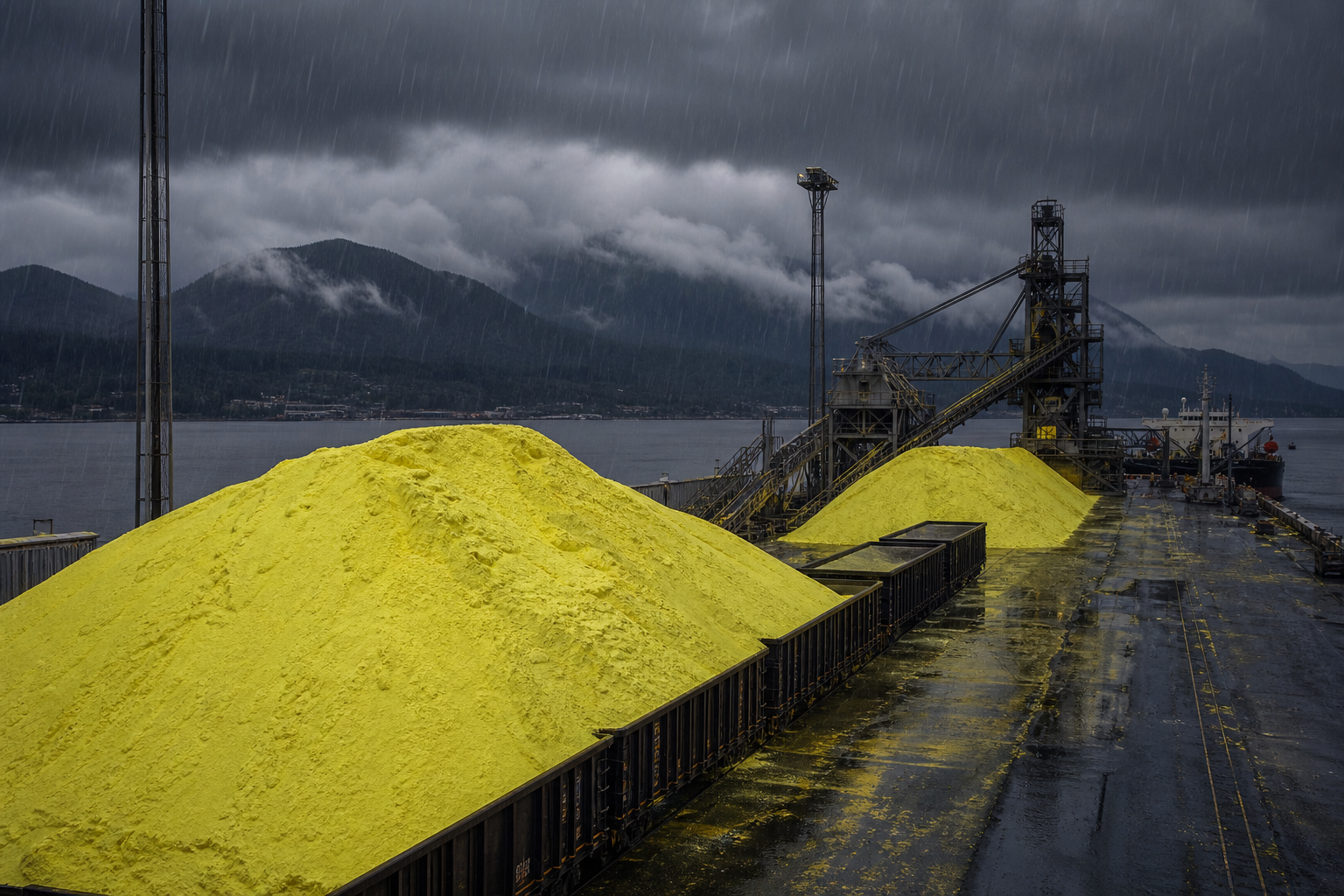
Early 2025 opened a new firm phase. Argus later reported that January-July 2025 Vancouver sulfur averaged $238 per tonne FOB, more than triple the $78 per tonne FOB average over the same period a year earlier. The first quarter sits inside that stronger half-year. Solid sulfur exports via Vancouver reached 2.04 million tonnes in January-July, up nearly 5 percent, with stronger Brazil and Cuba receipts and steady Australia volumes. January-February alone printed 621,000 tonnes, up 17 percent, China 278,000 tonnes, Australia 108,000, Indonesia 59,000. Higher FOB finally justified remelt of Alberta blocks for rail to British Columbia forming and vessel loadout. Port authority year-end figures would later show 3.5 million tonnes sulphur for full-year 2025, up 5 percent.
USGS Mineral Commodity Summaries 2026 reports Tampa, Florida contract sulfur began 2025 at $116 per long ton, then climbed to $270 in early April, eased to $252 in early July, and reached $310 in early October. The 15 March desk is the year-open plus the first weeks of that climb. $116 follows a 2024 path that opened at $69 and closed the fourth quarter at $116. 2025 opens where 2024 closed. The bull market is the rest of the year. Average US elemental sulfur unit value would jump to about $180 per tonne for 2025 from $46.42 in 2024. Licensed weekly assessment grids are not redistributed here.
Threats of 25 percent tariffs on US-bound Canadian goods from early April encouraged Canadian suppliers to look for alternative markets accessible via Vancouver for some product historically railed as liquid into the United States, though logistics contracts meant any diversion would be gradual. USGS still has Canada at 53 percent of US elemental sulfur imports for 2021-24. Molten rail is that share's physical counterpart. Forming west and loading dry bulk is the alternative door. January-February's 17 percent solid-export increase is too early to be that diversion. It is China, Australia, and Indonesia lifting more. Brazil's later January-August 122,842 tonnes, nearly threefold, is the Atlantic door opening.
Alberta inventory at the start of 2025 still sat in the neighbourhood of the 2024 year-end AER-linked print near 12 million tonnes, with Syncrude-area blocks historically holding most of the pile. The July 11.66 million tonne provincial close, lowest since May 2019, and the November Syncrude facility print just over 9.9 million tonnes are ahead. First-quarter 2025 is when remelt economics cleared, not when the low printed. Export-process costs above $150 per tonne had justified pouring during 2023-24 softness. A Vancouver average heading toward $238, and Tampa heading toward $270 in April, justified melting. Heartland's June remelt expansion to 700 tonnes a day is the capacity response that first-quarter prices called for.
CRU would later call 2025 a 1.9 million tonne global deficit year. World production in MCS 2026 was 84 million tonnes versus 83.9 million in 2024. US all-forms output slipped to 8.1 million tonnes. Canada 5.0 million tonnes 2025e. First-quarter 2025 does not yet have that deficit as a headline. It has a Tampa open at $116, a Vancouver stem up 17 percent in two months, and a FOB path that would triple the prior-year window. Metals demand, including Indonesian sulfur burners, and fertilizer restock are the bids that Argus would name under the autumn $305-310 FOB. CRU's 16 million tonne Indonesian nickel-related acid path is the structural metals bid. Vancouver's Indonesia line in January-February, 59,000 tonnes, did not yet show a boom. Origin concentration on the Middle East would keep Sulawesi from becoming Vancouver's default.
China still took 278,000 tonnes of the two-month stem, 45 percent. Full-year China would be 1.30 million tonnes, down 16 percent, a smaller share of a larger harbour. SunSirs' later 9.61 million tonne 2025 Chinese import year, down 3.5 percent, at $274 average, up 134 percent, is the national bid first-quarter Vancouver was selling into. December's 422,400 tonnes and the 12 December phosphate-export urge are fourth-quarter stories. March is still a China-led mix.
BC Insight's January Central Asia feature stressed that Tengiz Future Growth Project oil gains reinject associated gas and therefore do not add sulfur export volumes, even as 2024 Wellhead Management lifted output toward 2.65 million tonnes. Do not count FGP barrels as extra Kazakh cargoes. Existing Central Asian tonnes still moved through Russian ports in the first quarter, about 0.3 million tonnes a month in the later trade-press figure. Astrakhan damage and the Russian export ban are late-2025. Hormuz is February 2026. First-quarter 2025 is the firm phase without those corridor failures.
Alberta recovered sulfur still leaves mainly through the Vancouver stem. World tightness shows up there as stem tightness, remelt draws, and a Gulf-versus-Pacific basis. For corridor analysts, the first quarter marks when Pacific Canadian sulfur stopped looking like a soft-market residual and started looking like a high-utilization export program. UNCERTAIN: exact first-quarter-only Vancouver average inside the January-July $238 window. Weekly licensed prints are not redistributed here.
Canada Action would later cite 2025 production above 4.43 million tonnes and export value of $1.45 billion, rank 76 among Canadian export products, with 3.5 million tonnes through Vancouver. USGS's 5.0 million tonne all-forms line and BC Insight's later 4.7 million tonne elemental estimate, oil sands about 3.0 million tonnes, are the output those first-quarter loadings have to live inside. A 17 percent two-month jump does not mean Claus plants added 17 percent. It means forming plants, remelt, and loaders used more of the recovered stream that sour bitumen and gas already produced, and started paying to melt block that 2024's $78 FOB had left in pad. That is the Alberta-lens read on a Tampa open at $116 and a stem that was already busy before April's $270 step.
Key points
- Argus: Vancouver Jan-Jul 2025 avg $238/t FOB vs $78/t prior-year window.
- Vancouver solid exports Jan-Jul 2025: 2.04 Mt (+~5% YoY).
- Full-year 2025 port sulphur later 3.5 Mt (+5%).
- Elevated FOB flipped remelt economics versus pour-to-block.
- UNCERTAIN: Q1 2025 monthly FOB path within the H1 average.
30-day watchlist
- Tampa's April step versus the $116/lt year-open (USGS later $270 early April).
- Whether the 17% Jan-Feb Vancouver pace holds into March.
- Any tariff-list text that names or omits HS 2503.
- Early signs of Alberta remelt versus continued pour-to-block.
Sources
- Alberta sulfur inventories fall as exports climb (Argus)
- Port of Vancouver record cargo 2025
- Vancouver Jan-Feb sulphur exports rise by 17pc (Argus)
- USGS Mineral Commodity Summaries 2026 - Sulfur
Public reference summary. Weekly PRA assessments require a commercial license. Not investment advice.
Public-source summary. Not investment advice. Unsubscribe from the email edition: reply UNSUBSCRIBE or email [email protected].