
Outlook · 2026-04-15
Alberta inventory draw and Vancouver export strength into spring 2026
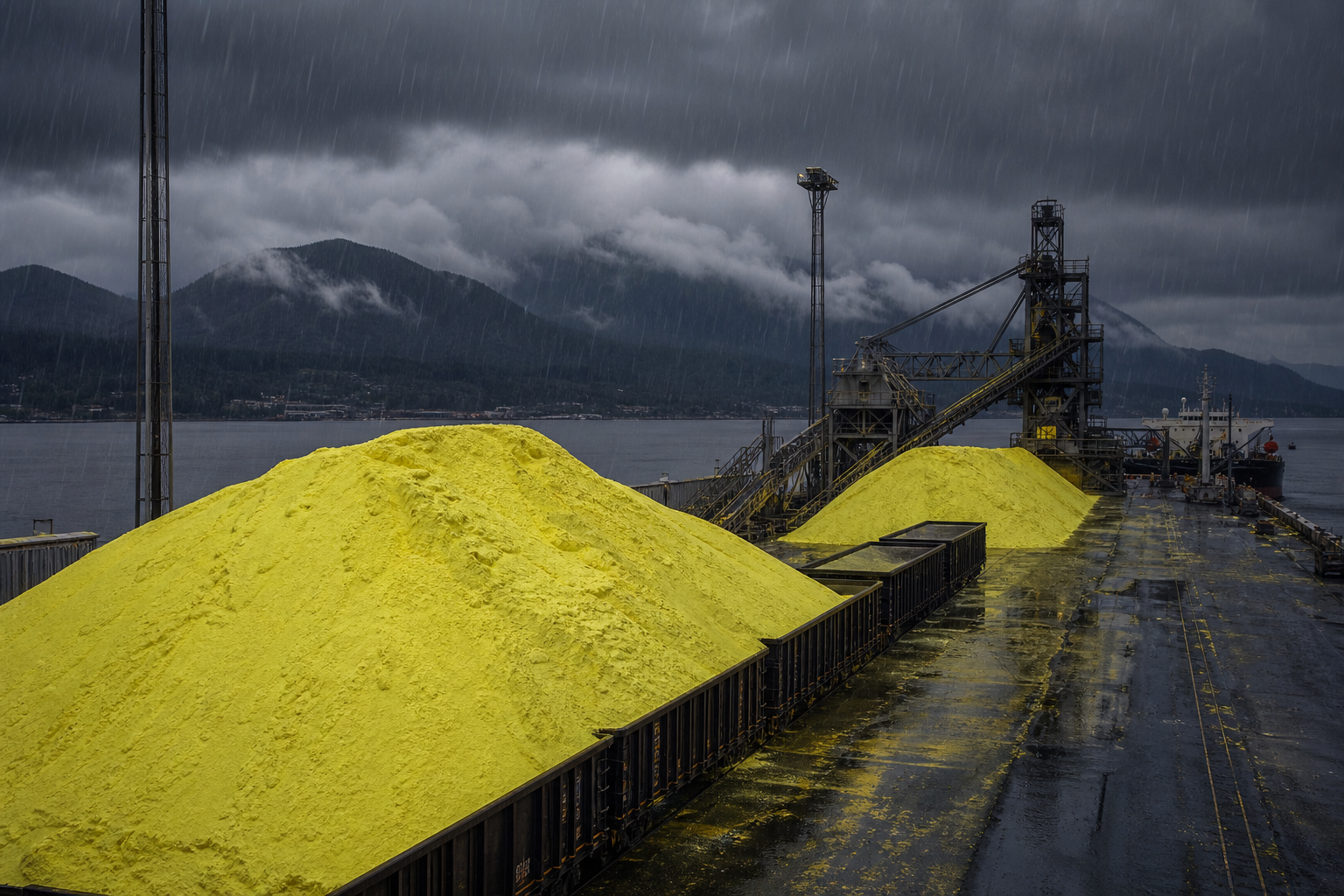
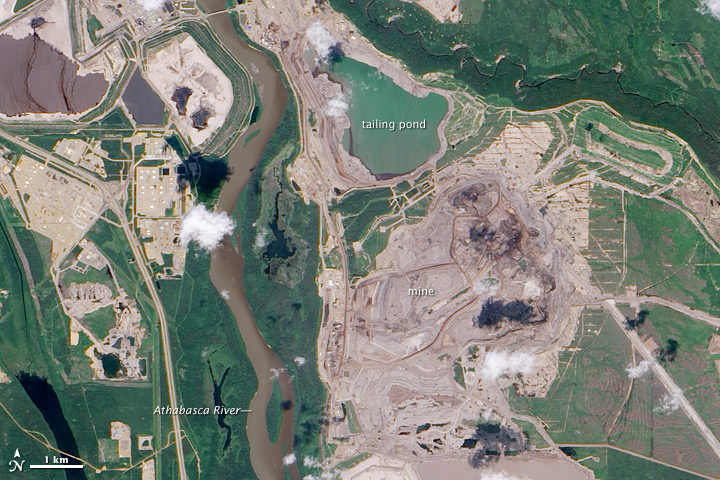
Alberta Energy Regulator data reported by Argus showed provincial sulfur inventories at 11.66 million tonnes in July 2025, down more than 377,000 tonnes year on year and the lowest since May 2019. The Argus item is at https://www.argusmedia.com/en/news-and-insights/latest-market-news/2731279-alberta-sulfur-inventories-fall-as-exports-climb. Elevated Vancouver FOB prices through 2025 supported remelting of block sulfur for rail to British Columbia forming plants and vessel loading at Vancouver and Port Moody. That 2025 draw is the physical starting point for a 2026 year in which Hormuz closed to commercial dry bulk on 28 February and Pacific tonnes became a swing book, not only a China book.
Argus reported solid sulfur exports via Vancouver of 2.04 million tonnes in January-July 2025, up nearly 5 percent year on year, with stronger flows to Brazil and Cuba and steady Australia volumes even as Indonesia receipts slipped. Brazil receipts nearly tripled year on year in that window. The later VFPA 2023-2025 Statistics Overview put full-year 2025 sulphur at 3,507,428 tonnes, up 5 percent, China 1.30 million tonnes (down 16 percent), Australia 597,000, Indonesia 371,000, United States 302,000 (up 191 percent). The January-July 2.04 million tonne Argus line and the 3.51 million tonne annual PDF are the same stem at different cuts. Monthly 2026 tables remain a public-path bridge. UNCERTAIN for April 2026: exact AER month-end stock for first-quarter 2026 was not confirmed in open sources at research time. Treat continued draw as directionally supported by industry press, not as a verified April print.
CRU and BC Insight later described Canadian inventory decline continuing into 2026, with additional remelt capacity planned by end-2026 and roughly 1.5 million tonnes of remelted Canadian sulfur expected over 2025-2030. The 23 March oil-sands note put 2025 Canadian elemental output at about 4.7 million tonnes, sixth globally, exports at about 4.57 million tonnes, third behind the UAE and Saudi Arabia, oil sands about 3.0 million tonnes or 63 percent of output. Capacity in the Fort McMurray belt is about 2.2 million tonnes a year (Suncor, Syncrude, CNRL Horizon) and about 700,000 around Edmonton (Shell Scotford about 580,000; Redwater about 130,000). Recovery tracks bitumen and sour gas. Remelt is the volume sulfur price can summon.
Export chain cost is often cited above $150 per tonne for remelt, rail, forming, and terminal, so draws require supportive FOB levels. USGS MCS 2026 showed Tampa climbing through 2025 from about $116 per long ton at the year open toward $310 in early October. CRU described Vancouver FOB averaging $238 per tonne in January-July 2025, triple 2024's $78, and ending the year near $485-495. SMM's later first-half 2026 review put FOB Vancouver from about $500 per tonne in January toward $825-950 by April, and first-quarter customs exports at 1.24 million tonnes. Those 2026 FOB ideas, if they hold, pay the $150-plus chain that 2024's $78 Vancouver average could not.
Hormuz is the demand shock sitting on that inventory file. BC Insight's 23 March Dire Straits note put about 45 percent of 39 million tonnes of international sulfur on a Hormuz transit. Force majeures and production cuts in Bahrain, Kuwait, Qatar, and Saudi Arabia spiked Brazil to $560-590 per tonne CFR and the Mediterranean to $580-590 in March reporting. TFI's March brief put high-risk Gulf exporters at about 41 percent of 2025 global sulfur exports, Iran adding about 4 percent, US conflict-exposed supply at 10-20 percent of domestic supply. Kpler dated the Strait closed to commercial dry bulk on 28 February. Stranded loaded cargoes on the order of 0.8-1.0 million tonnes featured in SMM's May recounting of the first quarter.
China's mid-March halt on MAP and DAP export declarations through August, named producers Yuntianhua, Xingfa, and Xinyangfeng, is the other large phosphate system's policy response. It reduces one source of global DAP and MAP and, if those plants cut runs, reduces China's sulfur import bid. VFPA's 2025 China line of 1.30 million tonnes is last year's bid. 2026 China will not automatically repeat it. USGS MCS 2026 put world output at 84 million tonnes, essentially unchanged, Canada at 5.0 million tonnes 2025e, US all-forms at 8.1 million, Canada at 53 percent of US elemental imports for 2021-24. The April file is still a 2025 stock-and-port file plus a six-week-old Strait closure. It is not yet the $705 Tampa third-quarter print. That Argus item, https://www.argusmedia.com/en/news-and-insights/latest-market-news/2851577-tampa-3q-liquid-sulphur-price-hits-record-705-lt, comes in July.
Alberta recovered sulfur still leaves mainly through the Vancouver stem. World supply shocks show up there as stem tightness, remelt draws, and a Gulf-versus-Pacific basis. The 11.66 million tonne July 2025 AER-linked print is the lowest since May 2019 because 2025 prices finally paid the remelt chain. 2026 prices, after Hormuz, pay it harder. Rail from Fort McMurray and Edmonton forming plants, not a pipeline, is how those blocks become cargo. Forming saturation, not Claus chemistry, is the near-term ceiling on how many incremental tonnes Canada can offer while Gulf dry bulk is missing.
USGS MCS 2026 unit-value and Tampa notes describe a 2025 market that was already tightening before the Strait closed. Apparent US consumption had slipped to 9.1 million tonnes. World output was flat at 84 million tonnes. The April desk is therefore not discovering a new producing country. It is watching whether Alberta block, Vancouver loaders, and US Gulf forming can cover a lane that carried nearly half of seaborne sulfur. First-quarter Canadian customs at 1.24 million tonnes say the Pacific answer started. Brazil CFR at $560-590 in March reporting says the Atlantic answer started. Neither number is a 1 million tonne a month replacement for Middle East loadings. Both numbers are why remelt economics, not a new Frasch mine, are the Canadian file into spring.
Key points
- AER via Argus: Alberta sulfur inventory 11.66 Mt in July 2025, lowest since May 2019.
- Vancouver solid exports Jan-Jul 2025: 2.04 Mt (+~5% YoY); Brazil receipts nearly 3× YoY in that window.
- Export chain cost often cited above $150/t (remelt, rail, form, terminal), so draws require supportive FOB levels.
- CRU (Mar 2026): Canadian inventory draw expected to continue in 2026; ~1.5 Mt remelted sales 2025-2030 (industry estimate).
- UNCERTAIN: April 2026 AER closing stock and Q1 2026 Vancouver tonnage pending next public statistical releases.
30-day watchlist
- Any AER-linked 2026 month-end stock that confirms or reverses the 2025 draw.
- VFPA or StatCan prints that show whether the 1.24 Mt Q1 customs pace holds.
- China phosphate-export halt implementation through April and May.
- Gulf dry-bulk loading or continued stranded-cargo commentary.
Sources
- Alberta sulfur inventories fall as exports climb (Argus)
- Oil sands sulphur (BC Insight / CRU)
- Vancouver Jan-Feb sulphur exports rise by 17pc (Argus)
- Dire Straits (BC Insight / CRU)
Public reference summary. Weekly PRA assessments require a commercial license. Not investment advice.
Public-source summary. Not investment advice. Unsubscribe from the email edition: reply UNSUBSCRIBE or email [email protected].