
Outlook · 2024-06-15
Moderate prices with continued Vancouver volume growth
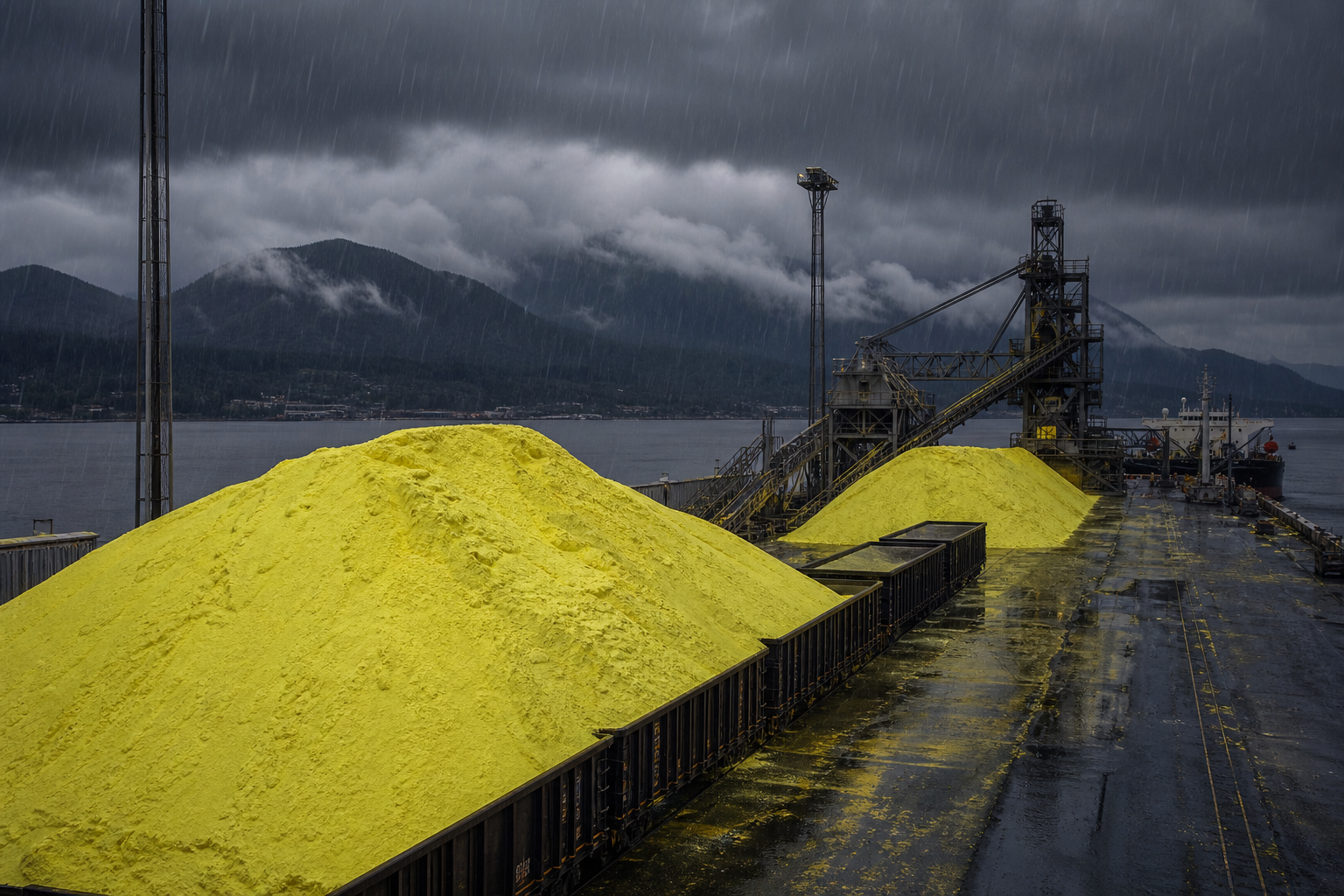
Mid-2024 kept sulfur in a moderate price band by recent cycle standards while Canadian export logistics stayed busy. USGS's path for Tampa showed early-July levels near $76 per long ton after the March $81 print and a $69 year-open. Vancouver's path to 3.35 million tonnes for the year implied a sustained run near 270,000 tonnes a month if evenly distributed. The Vancouver Fraser Port Authority later listed 3,348,398 tonnes of sulphur in 2024, up 7.9 percent from 3,103,912 tonnes in 2023. Industry commentary continued to flag rising nickel HPAL and battery-chain sulfuric acid needs as a medium-term demand layer atop phosphate. Alberta inventories were still high enough that a later 2025 draw would be meaningful.
Derived mid-2024 provincial stock near 12.0 million tonnes follows from Argus's July 2025 11.66 million tonne print and the more than 377,000 tonne year-on-year draw. UNCERTAIN: the exact July 2024 AER close; the 12.04 million tonne figure is arithmetic from Argus year-on-year commentary, not a restated AER table. That derived stock still offered remelt optionality that 2025 would exercise once Vancouver FOB cleared the export-process cost hurdle often cited above $150 per tonne. Argus later put the January-July 2024 Vancouver FOB average at $78 per tonne, more than a third of the $238 average over the same window in 2025. Mid-2024 FOB did not pay to melt remote block at scale. It did pay to form current oil-sands recovery and to keep the South Cheecham priller working through its startup issues.
South Cheecham is the second-quarter forming story. Argus reported the priller operational after January-May startup issues. Keyera's 2023 year-end report had placed commencement at the beginning of the third quarter of 2023, about 4,400 tonnes a day of forming near Fort McMurray, joint venture with Enbridge, gross cost about $285 million. A first full spring of operations is not a 2025 remelt boom. It is inland capacity converting upgrader sulfur into railable granules without a long molten haul to Edmonton for every tonne. Heartland Sulphur's Industrial Heartland terminal, about 4,500 tonnes a day of forming plus molten rail loading, remained the Edmonton-area counterpart. Forming saturation, not remaining Alberta block, is the speed limit on how fast Canadian inventory can answer a later Gulf hole.
Indonesian HPAL and Chinese phosphate are the two demand books under a moderate Tampa. Argus later put Indonesian HPAL acid demand near 5.17 million tonnes in 2024, with 7.12 million seen for 2025. CRU had already noted Indonesia sulfuric acid imports jumping from about 0.31 million tonnes in 2022 to nearly 1.1 million in 2023. S&P Global Energy put 2023 Indonesian sulfur imports at about 2.7 million tonnes, three times 2020. Mid-2024 is when coastal sulfur burners were substituting lower-cost elemental sulfur for imported acid. That bid competes with Florida phosphate for seaborne tonnes even when Tampa sits at $76. IFA saw MAP and DAP production up 4 percent to 66.8 million tonnes in 2024, led by China plus 2 million tonnes and Morocco plus 1.1 million, still below 2020 peaks. Phosphate was recovering. It was not booming.
China customs figures reported via Mysteel later put 2024 sulfur imports at 9.952 million tonnes, up 12.7 percent, average about $116.3 per tonne, down 8.4 percent year on year, despite domestic output rising to 11.13 million tonnes. Canada was second origin at 1.66 million tonnes, behind the UAE at 1.70 million, with Korea 1.19 million and Saudi Arabia 1.13 million. A 12.7 percent import increase at an 8.4 percent lower average price is a surplus-year Chinese bid. Mid-2024 is inside that cheap, large Chinese import year. 2025 would reverse it: 9.61 million tonnes, down 3.5 percent, at $274 average. The second quarter does not yet have that reversal. It has Gulf granular still competing with Vancouver into Yangtze plants whenever freight and FOB spreads aligned.
Kazakhstan and Saudi Arabia kept drawing stock for reasons that were not Canadian remelt economics. BC Insight reported Kazakhstan started a stock-drawdown programme in 2023 with crushed lump sulfur sales, later accelerating in 2024, adding roughly 1.2 million tonnes of extra 2024 sales, exports via Ust-Luga, Morocco taking about 73 percent of Kazakh sulfur sales in that export year. Saudi Arabia added roughly 0.15 million tonnes per quarter to its export programme from stock as storage neared capacity. CRU's later contrast is the desk read: Canada remelt is price-driven; Kazakh and Saudi draws are not. Mid-2024's $78 Vancouver FOB and $76 Tampa are why Alberta pad stayed pad while Central Asian and Gulf tonnes still left the yard.
USGS MCS 2025 estimated US 2024 production and shipments each 5 percent below 2023. MCS 2026 later put US all-forms at 8.32 million tonnes from 8.65 million, apparent consumption 9.36 million tonnes, unit value $46.42 per tonne. World output near 83.9 million tonnes in the 2024 revision, against 85.8 million in 2023 in MCS 2025, offered no dramatic supply surprise. Middle East refining upgrades flagged by USGS MCS 2025 to lift sulfur supply from 2025 are a 2025 story. Mid-2024 is continuity: moderate contracts, rising Vancouver tonnes, large provincial stocks. No Hormuz crisis yet. No record Tampa print yet.
Alberta recovered sulfur still leaves mainly through the Vancouver stem. World surplus shows up there as a harbour that can still load 3.35 million tonnes while FOB averages $78. The second quarter's public story is therefore logistics muscle, not scarcity. Buyers in Asia and the US molten-rail book were willing to program Canadian stems on term relationships. Phosphate affordability had not yet been rewritten by a $270 Tampa. Battery-metal sulfur demand was already large enough to matter when 2026 prices tested that affordability. Licensed weekly assessment grids are not restated here. UNCERTAIN remains the mid-2024 destination mix among Brazil, China, and Indonesia; VFPA's later 2025 destination table is a 2025 print, not a 2024 monthly matrix.
Key points
- USGS: Tampa near $76/lt by early July 2024 after March $81/lt.
- Vancouver on track for 3.35 Mt full-year 2024 sulphur.
- Derived Alberta stock ~12.0 Mt mid-2024 from Argus Jul 2025 YoY math.
- HPAL / battery sulfur demand rising in industry outlooks.
- UNCERTAIN: mid-2024 destination mix Brazil/China/Indonesia shares.
30-day watchlist
- Early-July USGS Tampa print confirmation near $76/lt.
- Any public note on South Cheecham run-rate after the May operational call.
- Indonesian first-half sulfur import pace versus 2023's 2.7 Mt year.
- Chinese first-half CIF versus the later full-year $116.3/t average.
Sources
- USGS Mineral Commodity Summaries 2025 - Sulfur
- Alberta sulfur inventories fall as exports climb (Argus)
- Port of Vancouver 2025 Statistics Overview
Public reference summary. Weekly PRA assessments require a commercial license. Not investment advice.
Public-source summary. Not investment advice. Unsubscribe from the email edition: reply UNSUBSCRIBE or email [email protected].