
Outlook · 2025-09-15
Destination diversification as Vancouver stays elevated
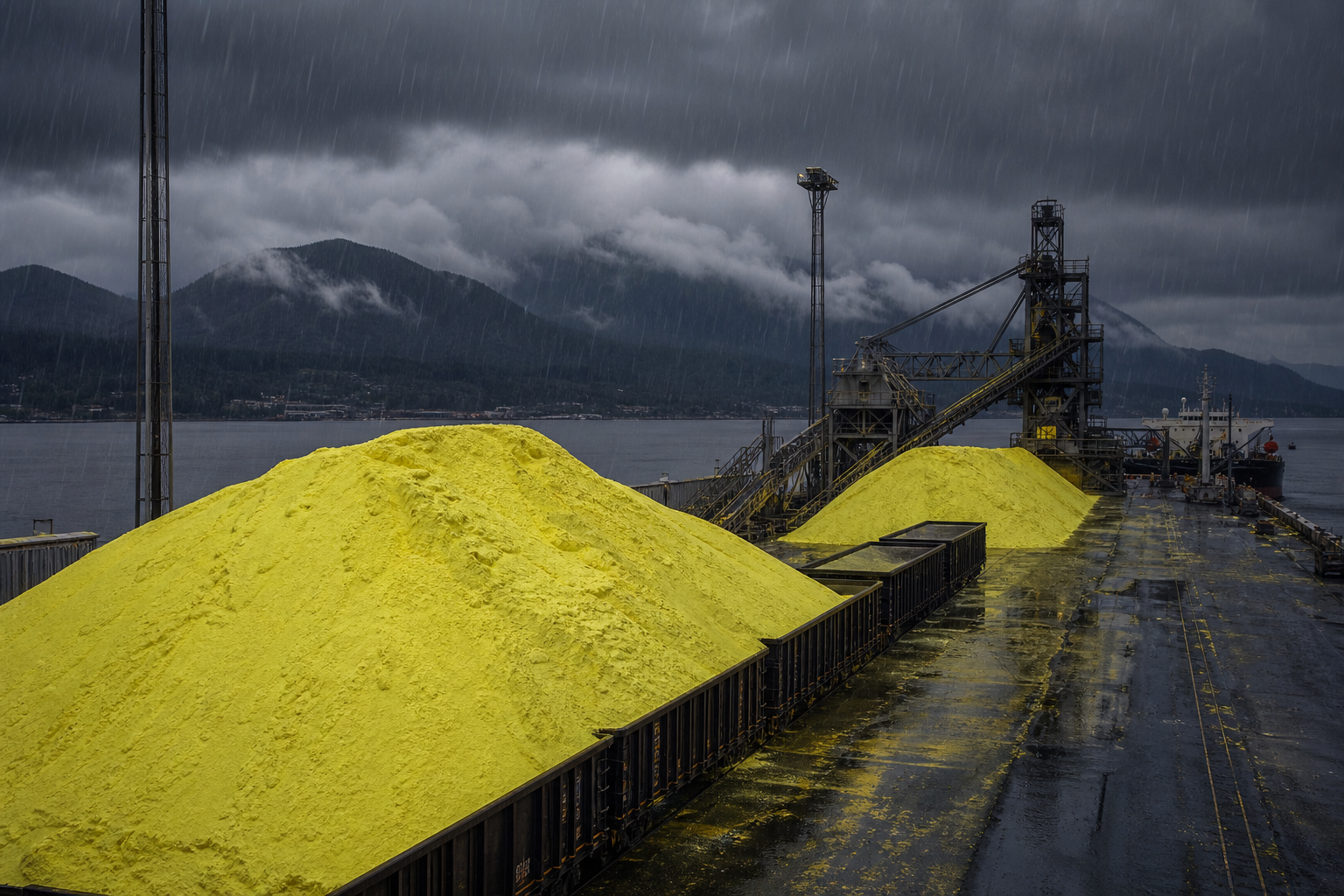
Third-quarter 2025 commentary emphasized destination diversification out of Vancouver. Argus's January-July window showed Brazil receipts nearly triple year on year to 122,842 tonnes, Australia at 356,234 tonnes, up 5 percent, and Indonesia softer, down 23 percent, despite the longer-run HPAL narrative. Cuba took 122,467 tonnes, up 96,041 tonnes. Solid sulfur exports via Vancouver reached 2.04 million tonnes in those seven months, up nearly 5 percent. The harbour was not only busier. It was selling to a different map.
Elevated prices since the 2022 highs, and especially versus 2024's soft window, kept Canadian solid competitive into Atlantic and Pacific buyers seeking non-Middle East options even before the 2026 Hormuz crisis. Argus put the January-July Vancouver FOB average at $238 per tonne, more than triple the $78 average a year earlier. Early October would print $305-310 per tonne. USGS had Tampa at $270 per long ton in early April, $252 in early July, then $310 in early October. Licensed weekly assessment grids are not redistributed here. The open Argus average and the USGS Tampa path are the public prices.
August loadings of 304,675 tonnes, down 5 percent from 320,178 a year earlier, showed buyers resisting elevated prices early in the third quarter. China took 133,907 tonnes of that August stem. The United States took 51,249 tonnes, treated in the reporting as likely Tampa-linked. January-August totals were still ahead at about 2.35 million tonnes, up 3 percent. Argus then estimated September near 386,000 tonnes, which would lift January-September to about 2.73 million tonnes, up 11 percent. Full-year VFPA later confirmed 3,507,428 tonnes, up 5 percent. August was a pause. It was not the year.
Remelt capacity expansions prepared the corridor for further draws. Heartland Sulphur increased remelt at its Edmonton-area terminal 40 percent to 700 tonnes a day and plans 1,500 tonnes a day by end-2026, triple the 2021 commissioning rate. Argus, citing AER, put provincial inventory at 11.66 million tonnes in July, down 377,000 tonnes year on year, the lowest since May 2019. Export-process costs above $150 per tonne had justified pouring in the soft years. $238 FOB justified melting. Further declines were expected into year-end if prices and liftings held. They held into October.
Brazil's surge is the Atlantic story. Argus later linked Brazilian preference for Canadian and Middle East origins to reciprocal-tariff risk on US goods. Early-year commentary on threats of 25 percent tariffs on US-bound Canadian goods from early April had already encouraged alternative markets via Vancouver for some product historically railed as liquid into the United States, with the caveat that logistics contracts made diversion gradual. One hundred twenty-two thousand tonnes to Brazil in eight months is gradual showing up as tonnes. It is also not a 1 million tonne a month Gulf replacement. It is a destination.
Indonesia's slip against a CRU nickel-related acid demand path of about 16 million tonnes a year in 2025, from 3.5 million in 2021, is the Pacific puzzle. Sulfur-burnt acid is the main domestic Indonesian source. Acid imports were still about 1.0 million tonnes. Chinese sulfuric acid exports heading toward 4.65 million tonnes for the year, up 73 percent, competed with elemental burners. A booming acid market can still take fewer Vancouver tonnes if Middle East elemental and Chinese acid fill IMIP first. CRU's later 76 percent 2025 Middle East dependence for Indonesian sulfur is that concentration. Vancouver is the alternative, not yet the default.
Fertilizer affordability risks were already noted as a potential demand-destruction brake. Apparent US consumption heading toward 9.1 million tonnes for 2025e, down from 10.2 million in 2023, is that brake in a USGS table. Chinese imports for the year would print 9.61 million tonnes, down 3.5 percent, at $274 average, up 134 percent, with December later falling to 422,400 tonnes. Third-quarter 2025 is still before that December pause and before the 12 December association urge to halt phosphate exports through August 2026. Affordability is already on the table.
Alberta recovered sulfur still leaves mainly through the Vancouver stem. World tightness, CRU's 1.9 million tonne deficit, shows up there as stem tightness, remelt draws, and a Gulf-versus-Pacific basis. Destination diversification is strategically important. A corridor that only serves one Asian tender calendar is more fragile than one that can swing toward Brazil or Australia when relative CFR bids shift. Public destination detail remains partial. Treat Argus and VFPA notes as attributed snapshots. UNCERTAIN: whether Brazil's surge was term-contract displacement from other origins or incremental phosphate sulfur burn, and whether that pull lasts into 2026 if Gulf solid returns.
Tengiz Future Growth Project still does not add sulfur export volumes, on BC Insight's January telling, because associated gas is reinjected. Existing Kazakh tonnes still moved through Russian ports in the third quarter, about 0.3 million tonnes a month in later trade-press figures. Astrakhan damage and the Russian export ban arrive in the fourth quarter. Hormuz arrives in February 2026. Third-quarter 2025 is therefore the last full quarter in which Middle East seaborne, CIS rail-to-port, and Canadian Pacific solid all still competed as if the map were intact. Vancouver's Brazil triple and US August receipts are the corridor practicing diversification before it would be required. The 11.66 million tonne July stock print is the inventory that practice was already drawing. Forming plants, not a new Frasch mine, set how many of those tonnes could leave by December.
Key points
- Argus Jan-Jul 2025: Brazil Vancouver receipts nearly 3× YoY; Australia +5% to 356 kt.
- Indonesia receipts slipped in the same window despite HPAL narrative.
- Canadian corridor acting as swing supply into multiple basins.
- Remelt expansions advertised as response to destock economics.
- UNCERTAIN: durability of Brazil pull into 2026 if Gulf solid returns.
30-day watchlist
- September Vancouver loading confirmation versus Argus's 386 kt estimate.
- October FOB versus the $305-310/t early-month band.
- Any AER-linked inventory update after the July 11.66 Mt print.
- Chinese autumn restock versus July's 1.094 Mt import peak.
Sources
- Alberta sulfur inventories fall as exports climb (Argus)
- Oil sands sulphur (BC Insight / CRU, Mar 2026)
- Vancouver sulfur exports down on year in Aug (Argus)
Public reference summary. Weekly PRA assessments require a commercial license. Not investment advice.
Public-source summary. Not investment advice. Unsubscribe from the email edition: reply UNSUBSCRIBE or email [email protected].