
Outlook · 2025-12-15
Vancouver closes 2025 at 3.5 Mt sulphur
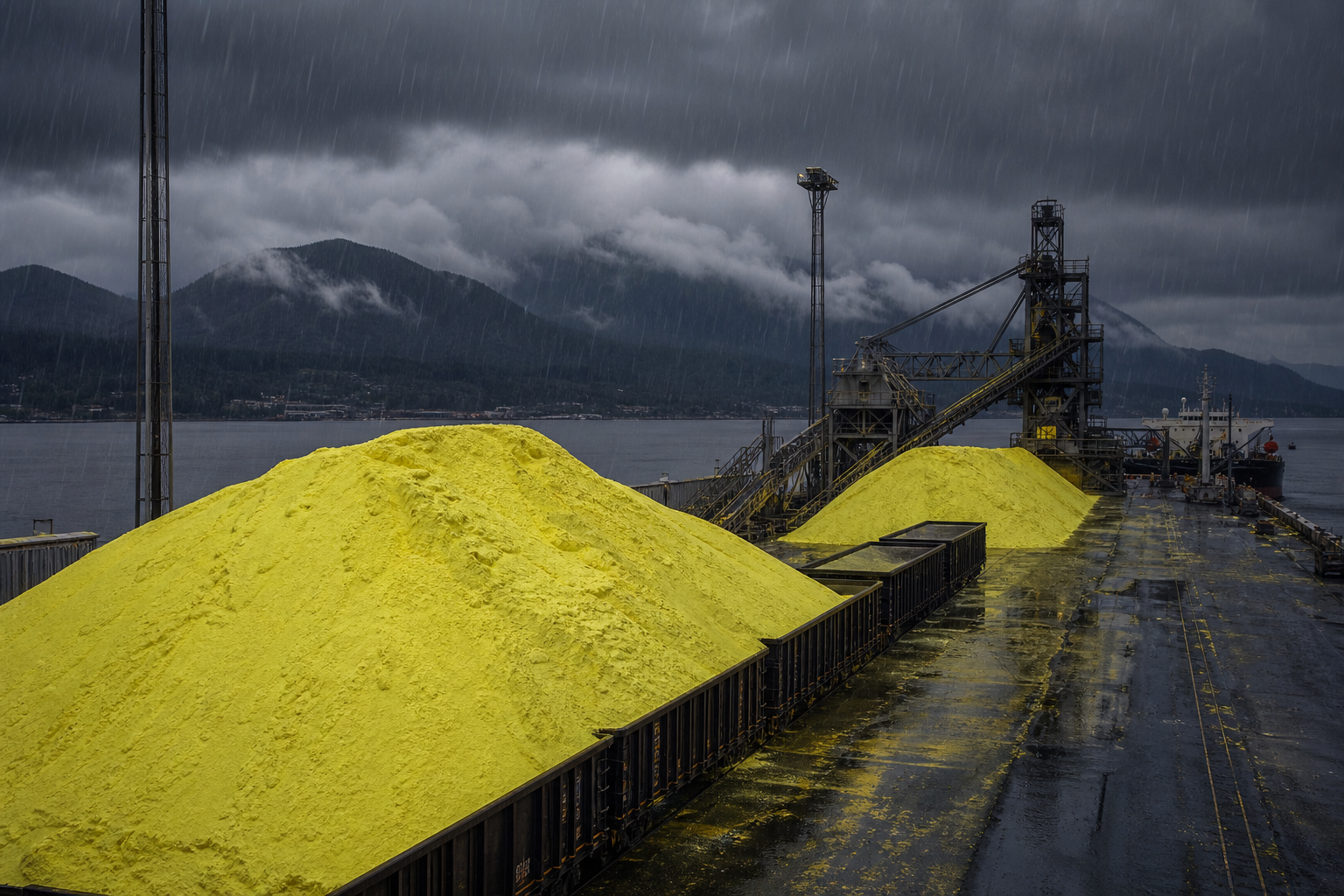
Port of Vancouver reported sulphur up 5 percent to 3.5 million tonnes in 2025 as part of a record overall cargo year, 170.4 million tonnes, up 8 percent. Fertilizer-category cargo reached 14.0 million tonnes, up 21 percent, including potash at a record 10.5 million tonnes, up 28 percent. The later 2023-2025 Statistics Overview PDF confirms sulphur at 3,507,428 metric tonnes. The five-year volume ladder from 2.29 million tonnes in 2021 to 3.51 million in 2025 is the clearest public series on Canadian Pacific solid sulfur growth without licensed assessments.
Destination mix inside that 3.5 million tonnes is the second story. China took 1.30 million tonnes, down 16 percent. Australia 597,000 tonnes. Indonesia 371,000 tonnes, down 13 percent. The United States 302,000 tonnes, up 191 percent. China remained the largest listed trading economy and a smaller share of a larger stem. Argus's January-August file had already shown Brazil at 122,842 tonnes, nearly threefold year on year, and January-July Cuba at 122,467 tonnes, up 96,041 tonnes. A corridor that can sell to Brazil, Cuba, Australia, and the United States when China pauses is less fragile than a corridor that only serves one Asian tender calendar.
Average 2025 FOB strength versus 2024 supported continued Alberta draws into year-end. Argus put the January-July Vancouver FOB average at $238 per tonne, more than triple the $78 average a year earlier, clearing the export-process cost hurdle often cited above $150 per tonne. Early October FOB printed $305-310 per tonne. USGS Mineral Commodity Summaries 2026 put Tampa from $116 per long ton at the year open to $270 in early April, $252 in early July, and $310 in early October, the highest fourth quarter since the second quarter of 2022. Average US elemental sulfur unit value jumped to about $180 per tonne from $46.42 in 2024. Licensed weekly assessment grids are not restated here.
Alberta inventory is the stock side of those prices. Argus, citing AER, put provincial closing sulfur inventory at 11.66 million tonnes in July, down more than 377,000 tonnes year on year, the lowest since May 2019. Industry commentary citing site inventory put Syncrude's Fort McMurray holdings at just over 9.9 million tonnes at end-November, the first sub-10 million tonne facility print since 2019, after a draw of nearly 400,000 tonnes from end-2024. Heartland Sulphur raised remelt capacity 40 percent to 700 tonnes a day and plans 1,500 tonnes a day by end-2026. Remelt, rail, forming, and terminal remain the sequence. Price pays it. Price does not skip it.
CRU estimated a global deficit near 1.9 million tonnes in 2025. World production in USGS MCS 2026 was 84 million tonnes versus 83.9 million in 2024. US all-forms output slipped to 8.1 million tonnes. Canada is listed at 5.0 million tonnes 2025e. The deficit is tradeable surplus, not missing Claus nameplate. Metals demand, including Indonesian sulfur burners, and fertilizer restock were the bids Argus named under the $305-310 FOB. CRU put nickel-related Indonesian acid demand near 16 million tonnes a year, up from 3.5 million in 2021, with sulfur-burnt acid the main domestic source and acid imports still about 1.0 million tonnes. Vancouver's January-July Indonesia receipts nonetheless slipped 23 percent. Origin concentration on the Middle East, 76 percent of Indonesian sulfur in the later CRU table, is why a Pacific alternative can boom in Brazil and still slip into Sulawesi.
China's 2025 elemental sulfur imports were 9.6084 million tonnes, down 3.46 percent, average price $274.02 per tonne, up 134 percent, per SunSirs. July peaked at 1.094 million tonnes. December fell to 422,400 tonnes as high overseas prices and phosphate-export pauses chilled buying. Bloomberg on 12 December reported Chinese fertilizer associations, after an NDRC-linked meeting, urging majors to suspend phosphate fertilizer exports until August 2026. Subsequent March 2026 customs measures limited export declarations for mainstream MAP and DAP. China's 2025 sulfuric acid exports near 4.65 million tonnes, up 73 percent, were the other sulfur-unit book, a flood that competed with elemental burners before the 2026 halt reversed it. Roughly 45 percent Chinese import dependence and a large Middle East share, per later SMM commentary, left the market exposed to any Gulf logistics shock. That exposure materialized in late February 2026.
Russia's late-2025 industrial sulfur export ban, tied to damage at Gazprom's Astrakhan complex, is the CIS door closing inside this fourth quarter. Kazakhstan had been moving about 0.3 million tonnes a month through Russian ports, with Morocco and Brazil as key destinations. The ban later extended through 2026 and combined with May 2026 rail curbs and a June 2026 Kazakh export suspension. Fourth-quarter 2025 should be read as the last pre-Hormuz quarter: Canadian logistics already hot, inventories already drawn, Middle East concentration still intact, CIS already impaired. UNCERTAIN: fourth-quarter FOB Vancouver average versus the January-July $238 window. The 3.5 million tonne port year does not require that average to be known. It requires forming plants, unit trains, and loaders, which 2025 had.
Alberta recovered sulfur still leaves mainly through the Vancouver stem. World tightness shows up there as stem tightness, remelt draws, and a Gulf-versus-Pacific basis. Closing 2025 at 3.5 million tonnes sulphur completes the public volume arc from the 2.29 million tonne 2021 trough. The next chapter is not a fifth step on that ladder. It is a Strait closed to commercial dry bulk on 28 February 2026.
Key points
- VFPA: 2025 sulphur 3.5 Mt (+5% YoY).
- Volume path 2021-25: 2.29 → 2.79 → ~3.10 → 3.3 → 3.5 Mt.
- Alberta stocks already drawn to multi-year lows by mid-2025.
- China import structure left Hormuz as a systemic risk into 2026.
- UNCERTAIN: late-2025 spot FOB vs H1 average.
30-day watchlist
- Confirmation of December Chinese import weakness versus SunSirs' 422,400 t.
- Any public FOB Vancouver Q4 average versus the Jan-Jul $238/t window.
- Implementation path of the Chinese phosphate-export urge into January.
- AER or facility inventory prints that extend the July 11.66 Mt / November 9.9 Mt Syncrude draws.
Sources
- Port of Vancouver record cargo 2025
- SMM analysis after sulfur breaks through $1,200
- USGS Mineral Commodity Summaries 2026 - Sulfur
- Alberta sulfur inventories fall as exports climb (Argus)
Public reference summary. Weekly PRA assessments require a commercial license. Not investment advice.
Public-source summary. Not investment advice. Unsubscribe from the email edition: reply UNSUBSCRIBE or email [email protected].