
Sulfur Wire North American sulfur intelligence

Outlook · 2026-03-15

2026 supply shock begins: Hormuz closure and stranded cargoes
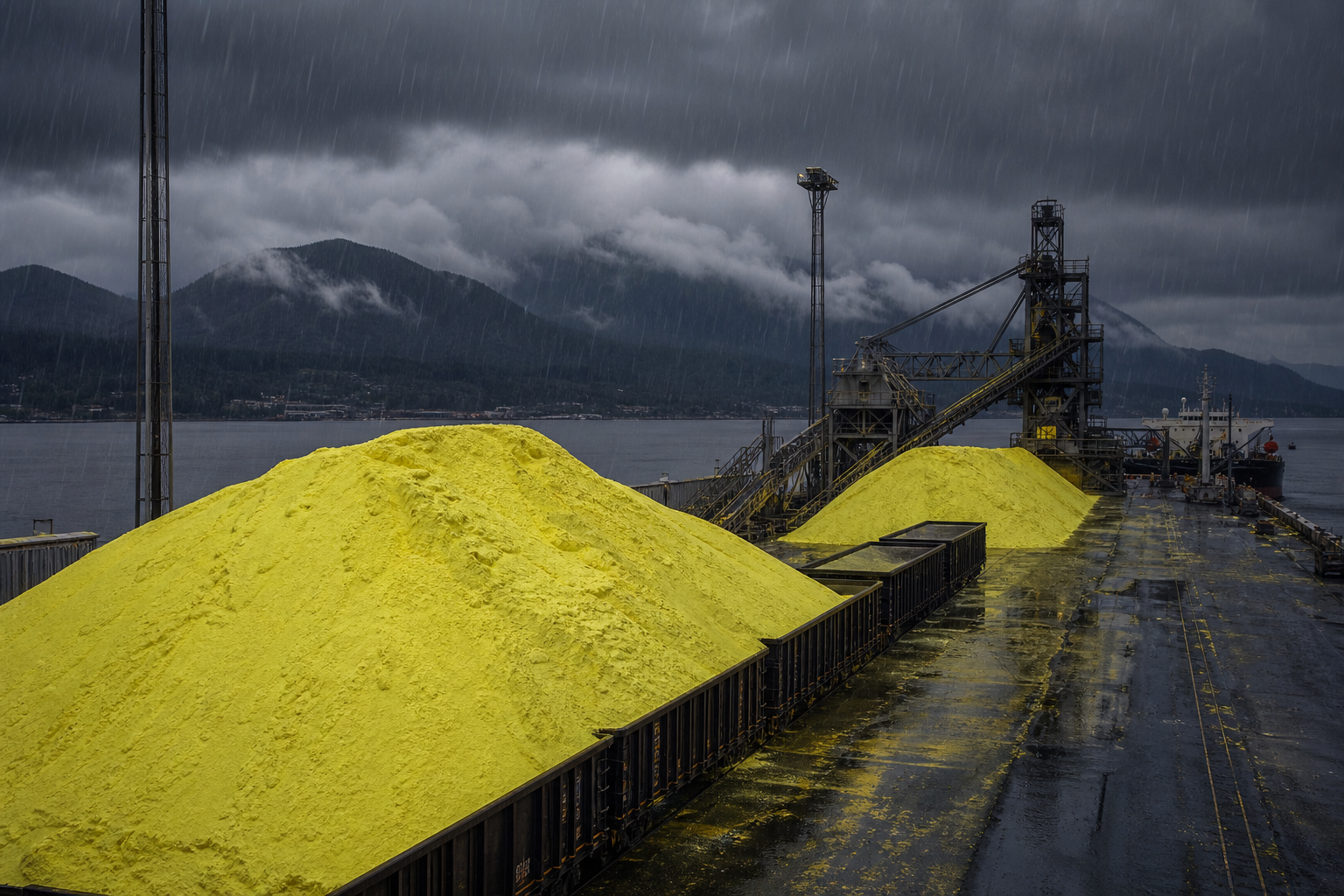
Alberta to Vancouver sulfur export corridor diagram
Alberta recovery and forming to rail to tidewater. The corridor that prices FOB Vancouver. Sulfur Wire · Original
Strait of Hormuz. More than half of seaborne sulfur normally transits this lane.

On 28 February 2026, open trade analytics from Kpler dated the Strait of Hormuz closed to commercial dry bulk traffic, immediately disrupting Middle East sulfur loadings that had supplied roughly 45-50 percent of seaborne trade. SMM and other open reports described stranded loaded sulfur in the Gulf on the order of 0.8-1.0 million tonnes and sharp drops in Middle East-China vessel counts. The Kpler frame is at https://www.kpler.com/blog/sulphur-sulphuric-acid-in-2026-the-feedstock-crisis-cascading-through-copper-nickel-fertilisers. Licensed weekly assessment grids are not restated here.

The Fertilizer Institute's March conflict brief put high-risk Gulf exporters, Saudi Arabia, Bahrain, UAE, Kuwait, and Qatar, at about 41 percent of global sulfur exports in 2025, with Iran adding about 4 percent, and nearly 50 percent of global sulfur trade tied to Hormuz exposure. US sulfur import reliance on conflict-exposed supply was estimated at 10-20 percent of domestic supply. USGS MCS 2026, posted in February, had just put Canada at 53 percent of US recovered elemental sulfur imports for 2021-24, Mexico 7 percent, Iraq 6 percent, Kazakhstan 6 percent, net import reliance 14 percent of apparent US consumption. Most US import tons are Canadian. The conflict-exposed slice is the margin that rerates Tampa when it disappears.

BC Insight's 23 March Dire Straits note, eight days after this brief's date stamp, would put around 45 percent of the roughly 39 million tonnes of sulfur transported internationally each year on a Hormuz transit. Pre-conflict tightness from the Russian export ban and a Tengizchevroil outage had already lifted prices toward 2008 levels. Force majeures and production cuts in Bahrain, Kuwait, Qatar, and Saudi Arabia then spiked Brazil to $560-590 per tonne CFR and the Mediterranean to $580-590 in March reporting. Those CFR bands are the first public delivered prints of the closure. They are not yet the $1,100 FOB neighbourhood of June and July. They are the break from the $500 pre-conflict FOB world.

Canadian customs exports of 1.24 million tonnes in January-March 2026 and FOB Vancouver rising from about $492 per tonne early year toward $680-720 featured in SMM's May analysis. Vancouver was framed as an unconstrained Pacific alternative, though rail and forming saturation limited upside tonnes. Russia's sulfur export restrictions compounded the dual-supplier shock. Byproduct inelasticity meant prices could not summon new Claus plants within the quarter. They could summon remelt, diversion, and demand destruction.

Alberta inventory is the remelt book. Argus, citing AER, put provincial stock at 11.66 million tonnes in July 2025, the lowest since May 2019. BC Insight's 23 March oil-sands note estimated Canada produced about 4.7 million tonnes of sulfur in 2025 and exported about 4.57 million tonnes, oil sands about 3.0 million tonnes or 63 percent, with about 1.5 million tonnes of blocked sulfur to remelt across 2025-2030. VFPA's 2023-2025 Statistics Overview, published this month, puts 2025 Vancouver sulphur at 3,507,428 tonnes, up 5 percent, fertilizer-category cargo up 21 percent to 14.0 million tonnes. Canada Action's fact sheet cited production above 4.43 million tonnes, export value $1.45 billion, rank 76 among Canadian export products, and the same 3.5 million tonne Vancouver line. USGS listed Canada at 5.0 million tonnes all-forms in 2025e and world output at 84 million tonnes, unchanged from 83.9 million in 2024.

China's mid-March halt on phosphate fertilizer export declarations through August, ChemNet at https://news.chemnet.com/news-3305.html, is the other large system's first policy response. Yuntianhua, Xingfa, and Xinyangfeng halted outbound MAP and DAP. Non-fertilizer phosphorus chemicals were described as outside the suspension. A country that keeps phosphate at home may also import less sulfur. That demand print would take until May's 268,300 tonne import month to show in customs. Mid-March is the declaration halt, not yet the import collapse.

Tampa molten for the first quarter sat near $496 per long ton in the desk's public-anchor file, after a 2025 path from $116 toward $310 in USGS MCS 2026 notes. The second-quarter $655 and third-quarter $705 records are still ahead. Argus would put the third-quarter contract at https://www.argusmedia.com/en/news-and-insights/latest-market-news/2851577-tampa-3q-liquid-sulphur-price-hits-record-705-lt. First-quarter 2026 is the supply-shock chapter opening, not the price peak. Mosaic, Nutrien, and Florida phosphate plants are watching Iraqi and other Gulf tonnes that USGS had counted as 6 percent of US elemental imports, and watching Canadian molten that is 53 percent.

Alberta recovered sulfur still leaves mainly through the Vancouver stem. World supply shocks show up there as stem tightness, remelt draws, and a Gulf-versus-Pacific basis. A corridor failure, not a mild basis move, is the right description of a Strait that carried nearly half of seaborne sulfur going closed in a week. UNCERTAIN: exact monthly Middle East export shortfall in million tonnes during March 2026. CRU later cited declines of more than 1.0 million tonnes a month after conflict onset. Stranded cargo tonnes and restart lag once transit resumes are the other open numbers. Forming plants between Edmonton and Fort McMurray will not raise Claus output because sulfur is expensive. They will form, rail, and load what sour-gas and bitumen plants already recover, and remelt block if FOB covers the chain.

The Port of Vancouver PDF published this month is last year's stem, not March loadings, and it still matters. A harbour that moved 3.51 million tonnes of sulphur in 2025, after 3.35 million in 2024 and 3.10 million in 2023, is the Pacific alternative buyers will call first. Destination mix already showed China slipping and the United States nearly tripling. First-quarter 2026 customs at 1.24 million tonnes say the call was answered. Rail and forming saturation, not a lack of yellow tonnes in Alberta, is the reason SMM and others said Canada could not fully replace Gulf seaborne in the first weeks. Oil-sands capacity near 3 million tonnes a year does not become 3 million extra export tonnes in March. It becomes whatever the forming plants, the unit trains, and the loaders can put on the water after remelt charges are paid.

Key points

  • Kpler: Hormuz closed to commercial dry bulk 28 Feb 2026.
  • SMM: Q1 2026 Canadian exports 1.24 Mt; FOB Vancouver ~$492 toward $680-720/mt.
  • Middle East historically ~45%+ of seaborne sulfur; China heavily exposed.
  • Byproduct inelasticity: price cannot quickly raise Claus output.
  • UNCERTAIN: stranded cargo tonnes and restart lag once transit resumes.

30-day watchlist

  • Confirmation of stranded Gulf cargo volumes versus the 0.8-1.0 Mt open estimates.
  • First VFPA or StatCan 2026 monthly that shows whether Q1's 1.24 Mt pace holds.
  • China phosphate-export halt implementation and any sulfur-import response.
  • Tampa Q2 contract talks versus the Q1 ~$496/lt public-anchor neighbourhood.

Sources


Public reference summary. Weekly PRA assessments require a commercial license. Not investment advice.

Alberta sulfur inventory, year-end prints Mt 2021 12 2022 12 2023 12 2024 12 2025 12 AER ST3 closing inventory (verified_public)
Alberta sulfur inventory, year-end prints AER ST3 closing inventory (verified_public)

Public-source summary. Not investment advice. Unsubscribe from the email edition: reply UNSUBSCRIBE or email [email protected].

2025-12-15Outlook stream2026-04-15