
Outlook · 2026-09-15
Hormuz counts stay in single digits as China benchmarks correct and phosphate idles hold

The North American sulfur desk entered the week of 15 September with the same structural tightness that has defined the market since February, but with fresher open prints on Hormuz transits, Chinese benchmarks, and phosphate run rates. Reuters and Kpler-linked shipping data put commodity vessel crossings through the Strait of Hormuz at four on Monday 15 September, down from ten on Sunday, with only two dry bulk carriers exiting and two oil tankers entering in ballast. That count sits far below the roughly 125 large commercial vessels per day the strait handled before the Iran conflict, and it matches the weekend pattern Reuters described on 14 September, when daily commodity transits fell to single digits against a ten-day average near fourteen.
BC Insight's 15 September market insight, citing Kpler, estimated roughly 450,000 tonnes of sulfur still waiting to transit Hormuz, a backlog figure that matters more to Alberta than a Tampa contract print because it defines how long Middle East tonnes stay off the seaborne market even when diplomats discuss corridors. The same note described global sulphur prices as broadly flat on the week while flagging Chinese port inventories at about 884,000 tonnes, an eleven-week high in its account, and Indian import offers in a 1,050 to 1,100 dollars per tonne CFR band. SunSirs' review for the week of 15 September put China import sulfur CFR in a 525 to 1,050 dollars per tonne range, with granular grades at 1,000 to 1,050 dollars per tonne, a spread that captures both distressed origins and premium formed product in the same import window.
On the Chinese domestic side, Shengyishe's national benchmark corrected sharply into mid-September after three flat sessions near 8,352 yuan per tonne. The platform published 7,869.00 yuan per tonne on Tuesday 15 September, down 483.33 yuan or 5.79 percent from the 14 September print of 8,352.33 yuan, and down 5.75 percent from the 1 September level of 8,349.00 yuan in open Shengyishe statistics. Wednesday 16 September brought a further decline to 7,704.00 yuan per tonne, down 165 yuan from the prior session, extending a clearly declining technical read as five-day spreads widened negative. For Vancouver netbacks, the correction is not a demand collapse: it is buyers refusing to chase offers higher while port stocks rise and import-cost math stays four-digit on Hormuz insurance and freight.
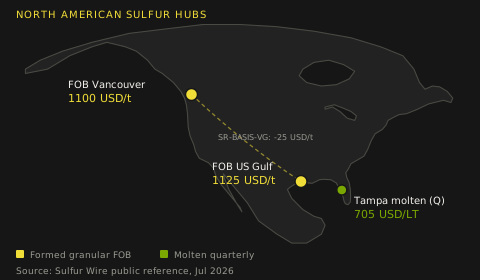
Atlantic phosphate economics remain the demand shock absorber. Open reporting through late August and early September still puts third-quarter 2026 Tampa molten sulfur contracts at a record 705 dollars per long ton delivered, the last material open-news Tampa settlement cited by Argus on 13 July 2026 at https://www.argusmedia.com/en/news-and-insights/latest-market-news/2851577-tampa-3q-liquid-sulphur-price-hits-record-705-lt. The Fertilizer Institute and farmdoc accounts linked sulfur above 1,000 dollars per tonne to US phosphate curtailments, including Mosaic idling at Faustina and Uncle Sam in Louisiana and reduced Central Florida run rates. Environment+Energy Leader and Louisiana WARN filings in August documented staffing cuts tied to extraordinary sulfur costs while ammonia at Faustina continued. Mosaic's third-quarter molten settlement at the same 705 dollars per long ton figure remains the contract anchor even as retail DAP averages climb toward 900 dollars per tonne in September open-market commentary.
Middle East contract postings have eased on paper without easing landed costs. QatarEnergy's September 2026 monthly sulfur contract remains at 880 dollars per tonne FOB in SunSirs' international reviews, down ten dollars from August's 890 dollars per tonne, while theoretical CFR southern China landed costs stay above 1,070 dollars per tonne once freight and Hormuz-route insurance surcharges are included. That split is why BC Insight can call prices flat globally while Indian CFR holds above 1,050 dollars and Chinese granular imports still print near 1,000 dollars at the top of SunSirs' range. Russia's industrial sulfur export ban through 31 December 2026 keeps a second large traded source off the market alongside the Hormuz impairment.
Geopolitics added noise without clearing the strait. Monday 15 September brought conflicting accounts of the Panama-flagged tanker EL GAIA off Oman, with Iran's IRGC describing a mine strike and US Central Command describing prior missile and drone damage, while Oman's Maritime Security Center reported a tow after fire northeast of Musandam. Persian Gulf Arab states postponed planned talks on Hormuz arrangements as attacks intensified. Salalah corridor summit plans that faltered on 14 September remain deferred. For sulfur specifically, Fertilizer Daily and WTO-AXSMarine trackers continue to describe fertilizer and sulfur flows through Hormuz as near zero despite memoranda on safe routes, which is consistent with four-vessel commodity days and a 450,000 tonne Kpler backlog rather than with normalized Gulf loadings.
Canada's trade lane stayed outside the September tariff escalation on elemental sulfur. Ottawa's counter-tariffs against US Section 338 duties took effect 8 September, but Finance Canada's published tables keep heading 2503 off the covered import lists, a point the desk flagged on 8 September and that remains unchanged as Washington expanded some lists effective 15 September on other goods. Canada still supplies the majority of US recovered sulfur imports in USGS Mineral Commodity Summaries framing, so Alberta forming plants and the Vancouver stem watch list text more than they watch Gulf FOB postings.
Alberta inventory remains the buffer price can actually move. Open trade press citing Alberta Energy Regulator data put provincial sulfur stock at 11.66 million tonnes in July 2025, down 377,000 tonnes year on year and the lowest since May 2019. No fresher public AER ST3 headline has landed in the September government checks, so the desk still treats 11.66 million tonnes as the last verified_public inventory anchor while exports draw stocks through the Vancouver corridor. BC Insight's March oil-sands note estimated oil sands contributed about 3.0 million tonnes, roughly 63 percent of national elemental output, with blocked Canadian sulfur remelt expected across 2025 to 2030 as capacity commissions. Recovery still tracks bitumen throughput, not the sulfur bid.
Vancouver exports remain the Pacific proof point. The Vancouver Fraser Port Authority 2025 Statistics Overview, posted in March, confirms sulphur through the port at 3,507,428 metric tonnes, up 5 percent year on year, with China at 1.30 million tonnes, Australia 597,000 tonnes, Indonesia 371,000 tonnes, and the United States 302,000 tonnes. Shanghai Metals Market's chain reviews put Canada on a swing-supplier path with 2025 exports at 4.25 million tonnes and early-2026 annualized values near 5.22 million tonnes, even as June customs data showed a month-on-month cooling. SunSirs and Shengyishe accounts describe sharply lower Chinese elemental imports in the first half of 2026, which makes Canadian tonnes more visible in the remaining import mix even when Chinese benchmarks fall.
Freight netbacks keep Pacific stems bid on delivered math, not Gulf postings alone. Public reference hubs on the desk, open-news and industry_estimate anchors only, still show FOB Vancouver granular mid about 1,045 dollars per tonne as of 1 June 2026 and FOB US Gulf granular mid about 1,125 dollars per tonne as of 1 July 2026, a Vancouver-minus-Gulf basis near 80 dollars per tonne on those prints. SunSirs' theoretical CFR above 1,070 dollars and granular import prints at 1,000 to 1,050 dollars imply Pacific loadings can hold netbacks even when Middle East FOB contracts print 880 dollars. Hormuz insurance surcharges that SunSirs has cited near 200 dollars per tonne on risk cargoes are the reason nominal contract cuts do not translate into lower Chinese landed costs. USGS Mineral Industry Surveys remain paused during the ScienceBase migration, so monthly US production prints are still December 2025 at latest posted.
The corridor read into mid-September is therefore tighter on documentation than on direction. Alberta recovered sulfur still leaves mainly through the Vancouver stem. World supply shocks show up there as stem tightness, remelt draws, and Gulf-versus-Pacific basis. Hormuz commodity transits in single digits, a 450,000 tonne sulfur backlog, and near-zero bulk sulfur crossings confirm Middle East seaborne recovery is still a freight and insurance problem, not a solved diplomatic problem. Chinese benchmarks near 7,700 yuan on 16 September signal domestic correction and high port stocks near 884,000 tonnes, not relief on import parity. Tampa at 705 dollars per long ton and phosphate idling above 1,000 dollar sulfur costs are the Atlantic prints. Canada on a multi-year export upswing with HS 2503 still off retaliation lists is the Pacific print.
Key points
- Hormuz commodity transits: four on Monday 15 Sep (Kpler/Reuters); Tuesday 16 Sep also four; ten-day average near 18 on 16 Sep.
- BC Insight 15 Sep: global sulphur flat; ~450 kt sulfur backlog at Hormuz (Kpler); China port stocks ~884 kt (11-week high); India CFR ~1,050–1,100/t.
- SunSirs week of 15 Sep: China import CFR 525–1,050/t; granular 1,000–1,050/t.
- Shengyishe benchmark: 7,869 yuan/t on 15 Sep (−5.79%); 7,704 yuan/t on 16 Sep; declining technical signal.
- Last open-news Tampa Q3 molten print: $705/lt delivered (Argus, 13 Jul 2026). Mosaic Q3 settlement cited at same figure in TFI/farmdoc chain.
- ME FOB reference: QatarEnergy Sep contract 880/t (SunSirs). Theoretical CFR China landed still above ~1,070/t with freight and insurance.
- Alberta AER-derived stock anchor: 11.66 Mt Jul 2025 (lowest since May 2019). VFPA 2025 sulphur through Vancouver: 3,507,428 t (+5% YoY).
- UNCERTAIN: whether insured bulk sulfur transits accelerate before year-end; whether Chinese port draws reverse the benchmark correction; whether US phosphate affordability caps further Tampa lifts.
30-day watchlist
- Daily Hormuz commodity transit counts and any Kpler revision to sulfur backlog estimates.
- Shengyishe benchmark and port inventory prints versus SunSirs granular CFR import range.
- BC Insight and open India CFR indications for Pacific netback comparisons.
- VFPA monthly updates and the next StatCan HS 2503 table that changes 2026 export pace versus 2025.
- Public confirmation of Gulf sulfur loadings returning above 1 Mt/month or further Mosaic/phosphate run cuts.
- Covered-list and retaliation calendar text for any HS 2503 listing.
Sources
- Market insight 41 (BC Insight, 15 Sep 2026)
- China import sulfur CFR review (SunSirs)
- Hormuz traffic dwindles (Baird Maritime / Reuters, 15 Sep 2026)
- Strait of Hormuz ship crossings remain in single digits (Reuters, 16 Sep 2026)
- Shengyishe sulfur benchmark 15 Sep
- Shengyishe sulfur benchmark 16 Sep
- Tampa 3Q liquid sulphur price hits record $705/lt (Argus open news)
- Sulfur shortage threatens global phosphate supply (Fertilizer Daily, 18 Aug 2026)
- Sulfur Wire desk intel 2026-09-08 through 2026-09-16
Public reference summary. Weekly PRA assessments require a commercial license. Not investment advice.
Public-source summary. Not investment advice. Unsubscribe from the email edition: reply UNSUBSCRIBE or email [email protected].